
God blesses those who mourn, for they will be comforted. [Matthew 5:4 (NLT)]
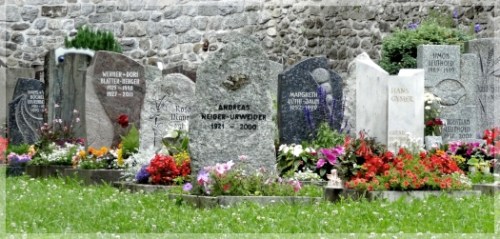 Many of the younger generation don’t know that yesterday’s Memorial Day originally was called Decoration Day and originated in the years following the Civil War. With some 620,000 dead from that conflict, communities began holding tributes to the fallen soldiers by reciting prayers and decorating their graves with flowers, flags and wreaths. The practice of leaving flowers at gravesites may have begun with the ancient Greeks who believed that, if the flowers took root and grew, the fallen had found peace or happiness in the afterlife.
Decorating graves with flowers and other memorabilia occurs throughout the year and isn’t limited to fallen warriors. When my mother-in-law was alive, I placed flowers on my father-in-law’s grave but I only did it because those flowers were important to her. They were placed to honor a living woman rather than her dead husband; I remember that wonderful man in other ways.
Forty-five years ago, we attended a Celebration of Life for my uncle and one of the speakers shared a quote that, even with Google, I have been unable to find. Although the exact wording is forgotten, the gist of it has continued to stay with me. In effect, its words were, “When you’re in a beautiful place, think of me so that I can come and share it with you!”
Whenever we attend the symphony, I remember that uncle and how much he would have enjoyed hearing the violins and reading the program notes. When I see a beautiful rose, dig in the garden, or read anything by C.S. Lewis, I remember my mother and how much she would have enjoyed the same things. When I schussed down a great run or enjoyed après ski fun, I thought of my brother and how he would have treasured a day like that. Watching men fishing in a mountain stream or hunters in their camouflage brings to mind my father and the avid sportsman he was. When my son discusses business with his father, I remember similar conversations my husband had with his dad and, whenever I bake spritz cookies or eat ripe red cherries, I joyfully remember our beloved GG. Even though I don’t think their spirits come and share those experiences, for a brief moment, those I’ve loved are again with me. Rather than decorating their graves, I have carried them forward into an unrealized future.
I want no flowers on my grave; then again, I want no grave. I do, however, want to be remembered. When the time comes, I hope my loved ones will remember me whenever they come upon a field of wildflowers, see a butterfly, eat chocolate chip cookies, hike the Rockies, or ski in deep power. Maybe they’ll even yell a joy filled “Ye-haw!” for me.
God promises to comfort us in our mourning. Indeed, there is comfort in our faith—in knowing that our loved ones who followed Jesus are with God and that someday we will be reunited. Although faith helps, it’s the memories of our loved ones that finally get us through the heartache of loss. Our memories are the way God heals our broken hearts.
As for decorating graves—we should send flowers to the living while they can still enjoy them. Smiles shared with our loved ones today will be far more welcome than tears at their gravesides tomorrow. As for flattering eulogies and glowing obituaries, perhaps those words of admiration should be spoken to the person now rather than about them at some later date.
Death leaves a heartache no one can heal; love leaves a memory no one can steal. [From a headstone in Ireland]
 Contrary to popular belief, the purpose of our long holiday weekend is not to celebrate the end of school or the beginning of summer. More than a day for picnics and play, this is a day to honor those men and women who died while serving our country. Just as we stop to give thanks for our nation’s blessings on Thanksgiving, Memorial Day is the time we should stop to give thanks for the people who sacrificed their lives to makes those blessings possible.
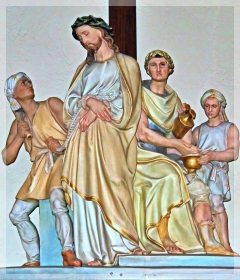 Pontius Pilate was the Roman prefect (or governor) of Judea from 26 to 36 AD. He was responsible for the collection of taxes, managed construction projects, and had the sole authority to order a criminal’s execution. His most important duty, however, was to maintain law and order and, if he couldn’t do it through negotiation, he did it by any means necessary.
 The Great Sanhedrin was the Supreme council (high court) of the Jews. Formed around 200 BC and modeled after the 70 elders who helped Moses in governing the Israelites, its 71 members consisted of scribes, priests, and elders with the high priest acting as its presiding officer. Along with religious and ritualistic Temple matters, the Sanhedrin addressed secular criminal matters, proceedings in connection with the discovery of a corpse, trials of adulterous wives, tithes, the preparation of Torah Scrolls, and drew up the calendar. As long as the Sanhedrin maintained public order and the Jews kept paying their taxes to Rome, the Romans were content to leave most of the nation’s judicial matters to them. While the Sanhedrin were supposed to administer justice, in the case of Jesus, they were anything but just; in fact, they sought perjured testimony.
 Rather than a religious sect, the Herodians were a political group who favored Herodian rule over direct Roman rule. Unlike previous kings of Israel, the Herodian kings were appointed by the Roman emperors. It’s been said that “You can’t tell the players without a scorecard,” and it seems that way with the various Herods we meet in the New Testament. It was Herod the Great, ruler of Judea from 37 to 4 BC, who enlarged the Temple Mount and began rebuilding the second Temple around 20 BC. This Herod was the “king of the Jews” who questioned the Magi and sought to kill the Messiah by slaughtering boys under the age of two. [Jesus was born between 6 and 4 BC.] After Herod’s death, his kingdom was divided among his sons and Herod Antipas became tetrarch of Galilee and Perea. This is the Herod who ruled Galilee throughout Jesus’ ministry—the one who married the wife of his brother (Herod Philip II), beheaded John the Baptist, and sent Jesus back to Pilate.
 Along with the Pharisees and Sadducees, the two other major sects or philosophies mentioned by the historian Flavius Josephus were the Zealots and Essenes. Religion and politics were one and the same in ancient Palestine and the Zealots movement originated with Judah/Judas of Galilee and Zadok the Pharisee. Their most basic belief was that any and all means were justified if it led to political and religious liberty for the Jews. When Judah was killed while leading a revolt around 6 AD, his followers fled to the desert and continued in guerilla warfare against the Romans.
 Devotions of the Heart