
Treat other people exactly as you would like to be treated by them—this is the essence of all true religion. [Matthew 7:12 (PHLLIPS)]
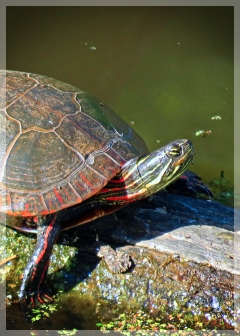 Once upon a time, a father gave his daughter a painted turtle. One morning, she ran to her father in tears and sobbed, “My turtle died!” Wanting to bring a smile back to his little girl’s face, Dad promised the reptile a lovely funeral after which he’d take her to their favorite fast-food spot for a happy meal and toy. When that did nothing to stop the flow of tears, he upped the ante by proposing to follow lunch with the latest Disney princess movie. As the sobbing slowed, he then promised they’d stop at the mall where she could ride on the merry-go-round and Ferris wheel. With only a few whimpers remaining, Dad topped off his offer with a promise to stop on the way home for a double scoop ice cream cone. Thrilled to finally see a smile on his daughter’s face, the relieved father reached into the tank to remove the dead turtle only to discover that it was alive and well and just had been enjoying a turtle nap. When he joyfully reported, “He’s not dead!” the disappointed girl’s response was, “Then can we kill it?”
Kids are naturally selfish and self-centered—just watch toddlers play and notice how often you hear the words “mine” and “gimme.” Children are self-absorbed little creatures, but so are adults—we’re just a bit more civilized in our selfishness. We may not grab, hit, or throw temper tantrums, but we still tend to put ourselves and our wants first. Since that unfortunate day in Eden, mankind has shown a preference for self-interest. We typically see the world only from our viewpoint rather than that of others or, more important, with the eyes of Jesus.
As members of the body of Christ, it is the lives of others that are to concern us. We are advised to share in both the joy and sorrow of our brothers and sisters. Sometimes, however, it seems easier to share in other people’s sorrow than in their joy. Just as the turtle’s fortuitous awakening meant the little girl lost her afternoon of fun, it’s rarely easy to rejoice in other people’s good fortune when we don’t share in it. Jealously, envy and resentment can rear their ugly heads. It’s especially difficult to rejoice when another person got the job we wanted, someone else’s child got the award, another person won the match, a co-worker got the praise or raise, or a friend heard the word “benign” when we heard the words “malignant” or “inoperable.” Nevertheless, regardless of our situations, other people’s good news should always be a reason for our joy.
“Genuine krab meat” isn’t truly crab; it’s an assortment of fish that has been skinned, boned, minced, and rinsed before being formed into the paste known as surimi. Fillers, flavor and color are added and the mixture is shaped into chunks or tubes and cut into blocks or sticks and cooked. Once cut up, it may look like a bit like the real thing, but there is nothing genuine about it. We’re called to love genuinely, even if it means we might have to skip the happy meal, movie, and ice cream. Let there be no imitation Christian love around here—it’s as tasteless and disagreeable to God as imitation crab.
 Earlier this week, I wrote about the ten Boom sisters giving thanks in their horrible circumstances. Because of the physical pain I’ve been experiencing these last several weeks, I know how easy it is to talk the talk but how hard it is to actually walk it. Indeed, when you’re hurting, giving thanks in all circumstances is far easier said than done.
 When we’re hurting, it’s not easy to reconcile how an entirely good, ever-loving, and all-powerful God can allow pain and suffering. The simplest answer is that, since He gave us free will, we can’t hold Him responsible for what mankind has done with that free will. We can’t blame God for global warming, tooth aches, concentration camps, genocide, cancer, red tide, wars, tornadoes, torn ligaments, or rising COVID cases. We alone are the ones responsible for mankind’s poor choices and the disease, death, destruction, and suffering that have accompanied us since we were evicted from Eden.
 Writing about pesky mosquitoes yesterday reminded me of a story told by Corrie ten Boom in her book The Hiding Place. As part of the Dutch resistance during World War II, Corrie’s family harbored Jews and others hunted by the Gestapo in their home. After being betrayed by a Dutch informant, the ten Boom family was arrested and imprisoned. Corrie and her sister Betsie ended up in the Ravensbrück concentration camp. That first night, as they shared a bed in the crowded barracks, Corrie discovered their bedding was infested with fleas. Betsie reminded her sister of the Scripture passage they’d read that morning from 1 Thessalonians: “Give thanks in all circumstances.” As they began praying, Betsie listed the things for which they could give thanks, such as their remaining together and having smuggled a Bible into the barracks. But, when she mentioned the fleas, Corrie’s response was, “There’s no way even God can make me grateful for a flea.” Betsie explained that the verse said all circumstances and not just the pleasant ones, so Corrie reluctantly joined her in a prayer of thanksgiving that even included the fleas.
 God saw all that he had made, and it was very good. [Genesis 1:31a (NIV)]
 Devotions of the Heart