
The seed cast in the weeds is the person who hears the kingdom news, but weeds of worry and illusions about getting more and wanting everything under the sun strangle what was heard, and nothing comes of it. [Matthew 13:22 (MSG)]
But blessed is the man who trusts me, God, the woman who sticks with God. They’re like trees replanted in Eden, putting down roots near the rivers—Never a worry through the hottest of summers, never dropping a leaf, Serene and calm through droughts, bearing fresh fruit every season. [Jeremiah 17:7-8 (MSG)]
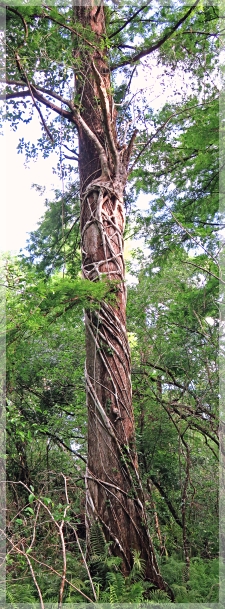 Most trees begin life as a seed in the soil of the forest floor and most trees also observe proper forest etiquette by not killing one another. The strangler fig (Ficus aurea), however, is not your typical tree. Rather than starting in the soil where the fig’s seeds would struggle to germinate in the darkness of the dense forest’s floor, strangler figs usually begin life high up in the forest’s canopy. Blown there by the wind or deposited by animals in their droppings, the sticky fig seed usually begins its life in the bark crevices of a mature tree.
Starting out as what’s called an epiphyte or air plant, the fig seedling gets its nutrients from the sun, rain and any leave litter on its host. As the seedling matures, it sends aerial roots down the host tree’s trunk to the soil while, at the same time, it sprouts upward towards the light and sends out branches. With a potential height of over 70-feet and spread as wide as 70-feet, the fig frequently becomes bigger than its host. Its roots and branches wrap themselves around its host constricting its trunk like a boa constrictor. While strangling its host, the fig also starves it. Its lush foliage steals the host’s sunlight and rain and its complex root system steals its nourishing ground water.
Like a tiny fig seed that eventually can destroy a giant cypress, worry can do the same to us if we allow it to take root. Like fig seeds, worries are opportunistic—when they find a niche, they move right in and start growing. They seem harmless enough at first but, once they take root, they dig into us and branch out into even more worries. Rather than wrapping around our trunk, worry wraps around our spirit. Just as the fig’s massive canopy of bright green leaves steals the sunlight from its host, worry robs the light and joy from our lives. The fig embeds itself into its host and worry entrenches itself in our hearts. A silent assassin like the fig, worry attacks our roots with doubt, starves our spirit, and tries to rob us of the living water of Jesus. Figs can live centuries and, while it may take decades for the murderous tree to assassinate its host, worry is just as lethal, but it works a whole lot faster. Worry not only kills our joy, vitality, strength, spirit, and faith, but it also strangles the life right out of us with high blood pressure, heart disease, and other stress related diseases.
As destructive as they are, figs aren’t all bad but there’s no plus side to worry. At least figs produce fruit that feeds the forest’s residents but worry can keep us from bearing fruit in our lives. The fig tree’s many nooks and crannies offer homes to critters like frogs, bats, and lizards but worries only offer hospitality to nasty things like anxiety, fear, doubt, and tension. Before killing their hosts, figs may even help them survive the high winds of tropical storms. The framework of fig roots and branches surrounding the host can stabilize the tree and keep it from being uprooted. Worry, however, destabilizes us and makes it that much harder to survive the storms of life.
The forest’s oaks, cypress, and palms have no choice in the matter when a fig takes root. Fortunately, as Christians, we do have a choice when worry tries to invade our lives! We have a divine Gardener who can rid us of worry, but only if we trust Him to do His work. Before we allow worry to take root, we must prayerfully hand our concerns to God as soon as they drop into our lives. It’s only by trusting God with tomorrow that we can bear fruit today.
Perhaps what our Father would have us learn is that worry is not for Him to take away, but for us to give up. [Kathy Herman]
 In a classic Peanuts comic (drawn by Charles Schulz), the meek Linus asked his bossy big sister Lucy, “Why are you always so anxious to criticize me?” She answered, “I just think I have a knack for seeing other peoples’ faults.” When Linus queried, “What about your own faults?” Lucy replied, “I have a knack for overlooking them.” Along with her over-sized ego, Lucy has what psychologists call “fundamental attribution error.”
 Our Colorado church had a large worship center with excellent acoustics so, when the local Jewish congregation wanted to present a concert of Jewish music by a well-known Jewish performer, we were happy to offer our venue to them. The Christians in attendance never expected the evening to end with Jews and Christians joining hands and dancing the hora around the church while singing “Hava Nagilah” (Let Us Rejoice). What the Jews hadn’t expected were the Bibles on the back of every chair. Before the concert began, many intently looked through them and, after the concert, they expressed their surprise at finding their Hebrew Scriptures in our Christian Bibles!
 Devotions of the Heart