HIS SANCTUARY

Don’t you realize that your body is the temple of the Holy Spirit, who lives in you and was given to you by God? You do not belong to yourself, for God bought you with a high price. So you must honor God with your body. [1 Corinthians 6:19-20 (NLT)]

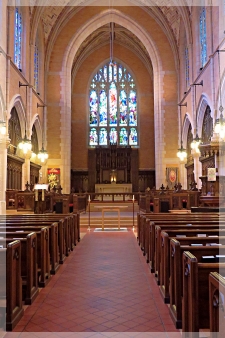
St. Paul's Cathedral - MNSince we both attended liturgical churches as girls, my friend and I were trying to recall the terms for the various parts of a traditional church building. We knew the foyer is called the narthex and the congregation sits the church’s nave. We also knew the altar rail usually separated the nave from the chancel in the front. It’s from the chancel that the service is conducted and where the altar, pulpit, and lectern are located. We even recalled that the sacristy was the room holding Communion supplies and linens. Since we were worshipping in a park that morning, my friend asked the location of our sanctuary. In historic usage, sanctuary and chancel were synonymous but, in modern usage, a sanctuary consists of the entire worship space of a church. With no building, we had no narthex, nave, or chancel but we did have a worship space; our sanctuary was a gazebo in a county park.


As God would have it, my next morning’s reading took me to today’s verse from 1 Corinthians. The Greek word usually translated as “temple” was naós, meaning a sanctuary, a divine dwelling-place, a temple, or place of divine manifestation. In Paul’s day, naós referred to the Temple proper, from the inner courts to the Holy Place with the seven-branched candlestick, golden incense altar, and showbread table all the way to the innermost area called the Holy of Holies—a place so sacred that it could be entered only by the High Priest once a year, on the Day of Atonement.

Having recently written about the lack of respect and reverence now common in a church sanctuary, Paul’s words gave me pause. The Temple and all its utensils—from the Ark, altars, and lamps to the snuffers, basins, oil, incense, and priest’s garments—were considered holy. Dedicated solely to serving God, they were not to be used for common or profane uses. If we are God’s sanctuary, a place of worship and the divine dwelling place of the Holy Spirit, do we treat ourselves with the reverence and respect due God’s temple? Are we solely dedicated to serving God? Are we ever used for vulgar, disrespectful, or profane purposes?

Do we ever desecrate our sanctuary by not treating our bodies properly? Do we treat them with the same care and regard we would Communion wafers, altar linens, or a Baptismal font? God’s sanctuary, however, is more than our physical bodies; it’s our entire being, our hearts and minds. Do we speak, read, look at, find humor in, think about, or do things we wouldn’t if we were in church? Do we always serve as a worship space of our amazing Triune God or just during prayers or worship service? Do we reflect the dignity, sanctity, and holiness that comes with being the house of God?

A great deal of responsibility comes with being God’s dwelling place. Just as the Temple was defiled in 168 BC when Antiochus Epiphanes sacrificed a pig on the altar of incense, our sins defile us. They are like obscene graffiti on a church walls, vandalism of the altar, defacement of the Bible, or leaving excrement on the pews. Preacher Harry Ironside reminds us, “How careful you and I ought to be that we grieve not that blessed One who dwells within, that we do not bring dishonor upon the name of the Savior who has sent His Spirit to live in our body.”

The Jews were so zealous about maintaining the purity of God’s sanctuary that a low fence  separated the court of the Gentiles from the rest of the Temple mount complex. Gentiles and ritually unclean Israelites were forbidden, on pain of death, from passing through its gates to the interior areas—the sanctuary of the Temple. Are we that zealous about keeping His dwelling place within us—His sanctuary—pure and undefiled?

For that matter, our brothers and sisters in Christ also serve as a dwelling place of God. Do we treat them with the same reverence and respect due God’s sanctuary? We should!

Don’t you realize that all of you together are the temple of God and that the Spirit of God lives in you?… All of you together are Christ’s body, and each of you is a part of it. [1 Corinthians 3:16,12:27 (NLT)]

Copyright ©2023 jsjdevotions. All rights reserved.

WHATEVER IT TAKES

But you will receive power when the Holy Spirit comes upon you. And you will be my witnesses, telling people about me everywhere—in Jerusalem, throughout Judea, in Samaria, and to the ends of the earth. [Acts 1:8 (NLT)]

Church of Columba - Spiez

“We will do anything short of sin to reach those who don’t know Christ,” was frequently said by the pastor of the mountain church at which we worshiped during our Colorado winters. His passionate words reflect the sort of zeal that mountain church has for reaching the unreached.

In Mark’s gospel, we find four men willing to do anything (short of sin) to bring someone to Christ. Jesus was in Capernaum where he previously healed the sick and demon-possessed. Upon hearing the news that Jesus had returned, these four men placed their paralyzed friend on a mat and carried him to the house where the Lord was preaching. Unfortunately, but the house was so mobbed that they couldn’t even get in the door! Unwilling to let a crowd of people keep their sick friend from Jesus, the men carried him up to the roof. While they didn’t sin, I’m not so sure they didn’t break the law when they dug up the thatch and dry mud, removed the tiles, and made a hole in the roof through which they lowered their paralyzed friend to Jesus’ feet.

Timothy certainly went “the extra mile” when the young man underwent circumcision just to become a more effective evangelist to the Jews. In obedience to the Spirit’s direction to go south to the Gaza road, Philip actually walked an extra 42 miles before even getting to that desert road and finally meeting the Ethiopian! His miles, however, pale in comparison to Paul’s! New Testament scholar Dr. Eckhard Schnabel estimates that Paul logged over 15,500 evangelism miles before arriving in Rome in 60 AD. 6,800 of those miles were by sea and another 8,700 were on land (presumably done on foot). Along with the blisters and callouses resulting from all that walking, Paul endured things like imprisonment, shipwrecks, being adrift at sea, whippings, beatings, imprisonment, and being stoned along with bandits, hunger, thirst, bad weather, and attacks from Jews, Gentiles, and false believers. Nevertheless, even when imprisoned, the Apostle relentlessly continued to spread the gospel of Christ in his letters.

Even after Herod ordered James’ death “by sword,” the first believers never stopped doing all they could to bring people to Christ. When Stephen was called before the high council, he knew his words would provoke them. Nevertheless, he courageously witnessed for Jesus until his last breath. Although Peter and John were beaten, imprisoned, and told to stop preaching, they continued to lead people to Jesus. The early church was determined to bring people to the Lord.

Jesus gave us a “great” commission (not a small one) when he told us to go into the world and preach the good news of God’s grace and love. Rather than a suggestion, that was an order and meant to be obeyed! When fulfilling His command, we’re not likely to endure things like circumcision, beatings, imprisonment, bandits, shipwreck, breaking through rooftops, or martyrdom. We don’t have to log over 15,000 travel miles or even walk 42 miles out of the way. Philip didn’t go far to bring Nathanael to the Lord and the woman at the well just ran back into town to bring people to Jesus!

The first believers were willing to do whatever it took to bring people to the Lord. Are today’s believers willing to do the same? Are we willing to leave our own personal comfort zone to bring light into darkness? Great things happened when Andrew invited his brother (Simon Peter) to meet Jesus. Are we even willing to ask our neighbors to church?

Evangelism is not a professional job for a few trained men, but is instead the unrelenting responsibility of every person who belongs to the company of Jesus. [D. Elton Trueblood]

Jesus came and told his disciples, “I have been given all authority in heaven and on earth. Therefore, go and make disciples of all the nations, baptizing them in the name of the Father and the Son and the Holy Spirit.” [Matthew 28;18-19 (NLT)]

Copyright ©2023 jsjdevotions. All rights reserved.

PLAYING WITH FIRE

A little yeast works its way through the whole lump. [Galatians 5:9 (NTE)]

CAMPFIREWhile baking banana bread, I decided to add in the last of the walnuts I found in the refrigerator. After pouring the dough into the prepared pans, I spotted a few walnut pieces that hadn’t made the mixing bowl and popped them in my mouth. One taste told me they were rancid! Not only are rancid nuts horrid tasting but, if enough are consumed, they can make you sick! Just as there’s no way to get a little bit of yeast out of a lump of dough, there was no way to get every last bit of nut nastiness out of the bread. A mere cup of nuts managed to turn more than eight cups of what should have been sweet and delicious into something bitter and sour. As I emptied the pans into the garbage, I recalled a sermon illustration about a thirteen-year-old girl.

The young teen tried to convince her mother that she should be allowed to see a certain R-rated movie. Explaining that there was only a little inappropriate material (such as casual sex, violence, bad language, nudity, and drugs) in the movie, she promised she’d take none of it to heart. Although the teen begged to be allowed to view it with her friends, her mother denied the request. Saying she couldn’t understand, the girl left in a snit to sulk in her room. Meanwhile, her mother set to work baking cookies in the kitchen. A wonderful aroma filled the house and, when the cookies were baked, the mother asked her daughter if she’d like to taste a special new recipe. Although they looked like regular chocolate chip cookies, her mother said something extra had been added. As the girl greedily reached for the tasty looking cookies, she asked about the new ingredient. Her mother explained that she added a small scoop of leavings from the cat’s litter box and mixed it into the batter. Since it was just a small scoop, it would hardly be noticeable and she was certain her daughter could ignore it while enjoying the rest of the cookie. It was then that the girl understood why her mother had prohibited the movie! Like the little bit of R in the movie, the incest in the Corinthian church, the false doctrine in Galatia, the rancid walnuts in my batter, and the cat poop in the cookies, even a little bit of sin is more than any of us should consume!

As adults, we consider ourselves wiser and more discerning than teenagers and, as Christ’s followers, we like to think we’re able to withstand the negative influences of today’s world. Let’s not fool ourselves. Temptation is all around us. While it may look as harmless as did that R-rated movie to the teen, we can’t step in the muck without getting a little dirty. When David, a “man after God’s heart,” snuck a quick look at the naked Bathsheba, he never intended it to grow into adultery and murder, but it did. Like David’s voyeurism, even a little bit of nastiness, corruption, vanity, revenge, arrogance, prejudice, spite, smut, hatred, deceit, or immorality has a tendency to produce something far worse.

Think of Solomon—supposedly the wisest man who ever lived. When he ignored the law by marrying Egyptian, Moabite, Edomite, Sidonian, and Hittite women, the king probably thought himself impervious their pagan beliefs. After all, with 1,000 women in his harem, what was the harm of a handful who worshipped idols? Solomon, however, wasn’t as wise as he thought! In his old age, those women “turned his heart to worship other gods instead of being completely faithful to the LORD his God.” [1 Kings 11:4] The one who so wisely warned others to avoid the path of sin foolishly walked right onto it!

Sin is deceptive and, sometimes it looks as harmless and enticing as fresh-baked banana bread or chocolate chip cookies. But, like a little scoop of cat poop or some rancid nuts in a bowl of batter, no matter how small, every little bit of bad we allow to enter our lives affects us. Solomon warned that, when we play with fire, we should expect to get burned. Sadly, he didn’t heed his own words. Let’s not make the same mistake!

The temptation once yielded to gains power. The crack in the embankment which lets a drop or two ooze through is soon a hole which lets out a flood. [Alexander MacLaren]

Can a man scoop a flame into his lap and not have his clothes catch on fire? Can he walk on hot coals and not blister his feet? [Proverbs 6:27-28 (NLT)]

Copyright ©2023 jsjdevotions. All rights reserved.

BEWARE THE YEAST (Yeast – Part 2)

“Why can’t you understand that I’m not talking about bread? So again I say, ‘Beware of the yeast of the Pharisees and Sadducees.’” Then at last they understood that he wasn’t speaking about the yeast in bread, but about the deceptive teaching of the Pharisees and Sadducees. [Matthew 16:11-12 (NLT)]

oleanderFor a single-cell microorganism member of the fungus family, yeast is mighty powerful. When added to water and flour, it starts to grow and multiply as it ferments the sugars in the flour, releases carbon dioxide, and causes the dough to rise. Moreover, once added to something, yeast can’t be removed. When a small amount of old fermented dough called a starter or seor is kneaded into flour and water, it permeates the dough and makes it rise. Some of the newly leavened dough can be saved to become the starter for the next batch of bread and so on.

In the right conditions, yeast seems nearly immortal. San Francisco’s Boudin Bakery uses a sourdough starter originating in 1849.  Scientists even revived yeast microbes from 4,500 years ago to make a loaf of bread! Indeed, the longevity, growth potential, and pervasiveness of yeast makes it a powerful substance.

The way yeast permeates and affects the dough with which it is mixed certainly makes it a good metaphor for the influence of one thing on another. Even though the Hebrew Scriptures never equated leavening with sin or evil, leaven and corruption had become almost synonymous with one another by the 1st century. Although Jesus used yeast’s power in a positive way as a metaphor for the growth and spread of the Messianic Kingdom, He also used yeast in a negative way; just as good can influence the world around it, so can bad.

At various times, Jesus used yeast as a metaphor for the power of evil to spread. He warned the disciples about the yeast of skepticism and unbelief found in the Pharisees, Sadducees, and Herod. In spite of the bountiful evidence of Jesus’ true identity seen in His miracles, the Pharisees and Sadducees demanded yet another “sign from heaven” to prove His authority. When Jesus appeared before Herod, the king wanted to see the proof of His miracles, as well. Not wanting His followers to be infected with such distrust or thinking of His miracles as entertainment for unbelievers, Jesus made this warning several times. Taking Him literally at first, the disciples thought Jesus was speaking of bread until they finally understood His meaning.

Along with the Pharisee’s skepticism, Jesus didn’t want his disciples influenced by their addition of the Talmud’s oral traditions to God’s final word in the Hebrew Bible or their hypocrisy in meticulously following the letter of the law while ignoring the most important commandment—that of loving God and their neighbor. Jesus also didn’t want His disciples affected by the Sadducees’ deceptive teachings. More concerned with their ritual purity than people’s welfare and politics than religion, the Sadducees denied things like angels, heaven, hell, and the resurrection while believing that people’s souls died with their bodies. As for Herod’s evil influence—Jesus didn’t want His disciples influenced by the actions of this immoral and self-indulgent man.

In letters to the Corinthians and the Galatians, the Apostle Paul also used yeast as a metaphor for the powerful influence of erroneous thinking and sinful behavior. When the Corinthian church ignored the flagrant immorality of one of its members, Paul warned them to remove him from the congregation lest such immorality spread through the entire congregation (as yeast does when added to fresh dough). In the same way, Paul warned the Galatians about the danger of accepting the perverted gospels of both the Judaizers (who insisted Gentiles had to adhere to Jewish laws like circumcision) and the Legalists (who preached a doctrine of salvation by works). Such false teaching was dangerous because, like yeast, it spreads out and affects everything with which it comes into contact.

Be it even a little false doctrine or immorality (whether sexual sin or things like abuse of power, financial fraud, deception, decadence, hate, hypocrisy, or gossip), when such evil is tolerated by the Church, it is like yeast. It’s evil works invisibly and will permeate and influence all that it touches. Just as a little leaven leavens the whole lump, a little sin can destroy the individual as well as the Church—the body of Christ. Let us beware!

Don’t you realize that this sin is like a little yeast that spreads through the whole batch of dough? Get rid of the old “yeast” by removing this wicked person from among you. Then you will be like a fresh batch of dough made without yeast, which is what you really are. [1 Corinthians 5:6-7 (NLT)]

Copyright ©2023 jsjdevotions. All rights reserved.

… AND GOING (Part 2)

Then I heard the Lord asking, “Whom should I send as a messenger to this people? Who will go for us?” I said, “Here I am. Send me.” [Isaiah 6:8 (NLT)]

I, the Lord of sea and sky, I have heard my people cry
All who dwell in dark and sin My hand will save.
I, who made the stars of night, I will make their darkness bright.
Who will bear my light to them? Whom shall I send?
Here I am, Lord. Is it I, Lord? I have heard you calling in the night.
I will go, Lord, if you lead me. I will hold your people in my heart.
[Dan Schutte]

elephantLast week, after singing we’d come in the opening hymn, we promised to go in the closing one: I the Lord of Sea and Sky. Originally written for a Roman Catholic ordination mass in 1981, it has found its way into many Protestant hymnals. As I sang the refrain, “Here I am, Lord. Is it I, Lord?” I thought of Samuel and Isaiah, both of whom were called by God and both of whom responded by saying, “Here I am.” I wonder if I would have responded as positively as did they. Like Moses, would I have protested or, like Jeremiah, say my age disqualified me? Would I simply have run away as did Jonah? Although Moses, Jeremiah, and even Jonah eventually answered God’s call, I’m not so sure I would have (although three days in the belly of a fish might have convinced me)!

Being a prophet was a little like being God’s press secretary. Acting as His spokesperson, the prophet conveyed God’s words and message to the people. Unlike a press conference, however, negative news didn’t get a positive spin and there was no quibbling about the meaning of words. Prophets didn’t speak off-the-record, dissemble, beat around the bush, or use alternative facts and half-truths. With no need to be re-elected, God never worried about approval ratings and His prophets spoke only the unadulterated and often unpopular truth.

While a bearer of glad tidings is popular and welcome, indicting people for their sins  or bringing a message of judgment and destruction was no way to win a popularity contest in Judah, Israel, and the surrounding nations. As the frequent bearers of reproach, dire warnings, and sad tidings, prophets often were ignored and persecuted. Nevertheless, Isaiah and the others reported for duty and took on a task that few would want.

God’s prophets answered His call because they trusted and loved Him. They knew He didn’t bring the Israelites to the edge of the Red Sea only to have them drown in the waters or be captured by the Egyptian soldiers nor did He send them through the wilderness only to have them die from starvation or lack of water before arriving in Canaan. God didn’t put Noah and the animals on that Ark without bringing them to dry land, He didn’t have Joshua march around Jericho without giving him victory, and He didn’t send David out to meet Goliath without those five smooth stones for his sling! Confident that God would provide all they needed, those prophets answered His call.

The pastor’s choice of opening and closing hymns had us both coming and going that day. The hymns were a vivid reminder that it’s not enough just to come to Jesus; He also expects us to go out into the world for Him. He calls us to service—to be His messengers and spread His word, light, and love to the world around us. When He calls, do we answer or do we pretend we don’t hear? Do we trust God to provide whatever we need or do we doubt and reject Him? Even though God warned his prophets that most people wouldn’t listen to them, let alone heed their words, they heeded His call by saying, “Here I am. Send me.”  Will we do the same?

We are not diplomats but prophets, and our message is not a compromise but an ultimatum. A.W. Tozer]

But you will receive power when the Holy Spirit comes upon you. And you will be my witnesses, telling people about me everywhere—in Jerusalem, throughout Judea, in Samaria, and to the ends of the earth. [Acts 1:8 (NLT)]

Copyright ©2023 jsjdevotions. All rights reserved.

PRIDE BLINDS

Sin whispers to the wicked, deep within their hearts. They have no fear of God at all. In their blind conceit, they cannot see how wicked they really are. [Psalm 36:1-2 (NLT)]

prickly pear cactusI enjoy stopping for a short stroll on the boardwalk of a local nature preserve that is home to well over 100 gopher tortoises (a protected species) and a wide assortment of native plants. The boardwalk is low to the ground and has no railing because it’s not there to protect people from the alligators and snakes of the swamp; it’s there to protect the animals and their dry scrub habitat from people! Several signs are posted about not stepping off it onto the fragile landscape. When I spotted an absolutely beautiful prickly pear cactus in full bloom, I was disappointed it was out of decent photo range. Since mine had been the only car in the parking lot, I was tempted to disobey the posted signs. “I really want that photo! Who’d know? What harm could I do?” I asked myself. If I’d seen someone else stepping off the boardwalk, however, I would have admonished them for their lack of environmental concern! Recognizing sin’s whisper in my ear, I stayed put. Nevertheless, I realized how tempting it is to think my desires are more important than anything or anyone else.

It’s easy to get so caught up in the importance of ourselves—our projects, possessions or purpose—that we forget it’s not really about us. Last year, a town north of us had a severe water shortage and asked residents to water lawns only once a week—yet, despite the city’s pleas, people disregarded the restrictions. Apparently, their landscaping took priority over the needs of their community. When no water comes out of the fire hydrants, however, the color of their grass will be of no importance.

I regularly see drivers run red lights, fail to yield right of way when entering roundabouts, and multi-task by texting, applying make-up, eating, and reading while driving. Apparently, their desire to get somewhere on their timeline takes precedence over anyone else’s safety. Of course, the few seconds they may save will be lost in an accident!

Why do we disobey laws (or God) so easily? What was it that made me (even briefly) think I deserved a photo denied to any but those with the finest camera and telephoto lens? The answer C.S. Lewis might give is pride. Calling it the “complete anti-God state of mind,” he considered pride the underlying cause of every other vice.

Competitive in nature, pride causes people to look down on things and other people. Could it be pride that makes people decide their lawns are more important than their city’s water supply or their destination is more important than the safety of their fellow drivers? Is it pride that causes us to think God’s commands, government regulations, traffic laws, community requirements, ethical principles,  moral standards, and even the rules of common courtesy apply to everyone else but not to us? Is it pride that makes us forget about doing unto others as we would have done to us? Could it be pride that makes us think that we deserve bigger, better, faster, fancier, sooner, or more than the other guy? It certainly was pride that allowed me to briefly think I deserved a photo op denied to others!

Pride means more than enmity between people; it is enmity to God. Faced with one infinitely superior to him, it was Satan’s pride that caused him to rebel and fall from heaven. It is our pride that makes us rebel, as well. We foolishly think that we’re better, smarter, richer, prettier, wittier, grander, saintlier, and more deserving than anyone else. We’re not!

It is pride which has been the chief cause of misery in every nation and every family since the world began. …Pride is spiritual cancer: it eats up the very possibility of love, or contentment, or even common sense. [C.S. Lewis]

“Scoffer” is the name of the arrogant, haughty man who acts with arrogant pride. [Proverbs 21:24 (ESV)]

Haughty eyes, a proud heart, and evil actions are all sin. … Mockers are proud and haughty; they act with boundless arrogance. [Proverbs 21:4,24 (NLT)]

(A week later, I came across another cactus right beside the walking path in the Botanic Garden. Thank you, God!)

Copyright ©2023 jsjdevotions. All rights reserved.