HARVEST HOME

And the servants of the master of the house came and said to him, “Master, did you not sow good seed in your field? How then does it have weeds?” He said to them, “An enemy has done this.” So the servants said to him, “Then do you want us to go and gather them?” But he said, “No, lest in gathering the weeds you root up the wheat along with them. Let both grow together until the harvest, and at harvest time I will tell the reapers, ‘Gather the weeds first and bind them in bundles to be burned, but gather the wheat into my barn.’” [Matthew 13:27-30 (ESV)]

Come, ye thankful people, come, raise the song of harvest home;
all is safely gathered in,
ere the winter storms begin. [Henry Alford]

Because the pastor’s sermon was about being thankful, she’d selected “Come, Ye Thankful People, Come” as the evening’s opening hymn. Henry Alford wrote this hymn in 1844 for village harvest festivals in England called Harvest Home. Rural churches would celebrate the harvest by decorating with pumpkins and autumn leaves, collecting the harvest bounty, and then distributing it to the needy. Because of its seasonal harvest imagery, we usually sing this hymn in November at Thanksgiving but this was mid-July! Reading the hymn’s words out of their traditional Thanksgiving context, I understood their meaning in an entirely different way.

While the literal meaning of “harvest” is the gathering in of crops, when Jesus spoke of the harvest, He used it as a metaphor for the gathering of souls into the kingdom. With its references to Jesus’ words about the harvest, Alford’s hymn is more than a song celebrating a bountiful crop of wheat, barley, oats, and potatoes; it is a metaphor for the final judgment and Christ’s return! The first verse, with its call for people to come to the harvest, alludes to Jesus’ words about the coming harvest being great but the workers being few. It reminded me that we all are called to be workers in His field!

The second verse’s, “All the world is God’s own field, fruit as praise to God we yield; wheat and tares together sown are to joy or sorrow grown,” combines imagery from Jesus’ parable of the growing seed in which the harvest comes through God’s provision and His parable of the wheat and tares. The wheat seeds symbolize the true believers sown by Jesus and the tares or weeds the bad seeds sown by Satan. While both the grain and weeds grow side by side, only the wheat will grow to joy while the tares will grow to sorrow! Alford concludes the second stanza with the simple prayer: “Lord of harvest, grant that we wholesome grain and pure may be.”

The apocalyptic theme of the hymn becomes clear in the third and fourth verses: “For the Lord our God shall come, and shall take the harvest home.” Repeating imagery from Matthew 13, Alford continues: “Giving angels charge at last, in the fire the tares to cast; but the fruitful ears to store in the garner evermore.” Both wheat and tares will receive their reward; the wheat (the righteous) will be stored in the barn and enter into the Kingdom but the tares (false believers) will be gathered and burned in Hell.

How can a hymn about the final judgment be so joyful and filled with thanksgiving? Because, for a believer, the message of the gospel is one of hope. There will be no tares in heaven. As Alford says, it will be “free from sorrow, free from sin.” The hymn concludes with a prayer that Jesus would soon return for the harvest: “Even so, Lord, quickly come, bring thy final harvest home … come, with all thine angels, come, raise the glorious harvest home.”

As believers, we can be thankful because we’ve read the last chapter. We know our story won’t end with “weeping and gnashing of teeth.” Instead, we will “shine like the sun in the kingdom” of our Father!

Lord of harvest, grant that we wholesome grain and pure may be. [Henry Alford]

Just as the weeds are gathered and burned with fire, so will it be at the end of the age. The Son of Man will send his angels, and they will gather out of his kingdom all causes of sin and all law-breakers, and throw them into the fiery furnace. In that place there will be weeping and gnashing of teeth. Then the righteous will shine like the sun in the kingdom of their Father. He who has ears, let him hear. [Matthew 13: 40-43 (ESV)]

Copyright ©2024 jsjdevotions. All rights reserved.

THE DRAGNET

Again, the kingdom of heaven is like a net that was thrown into the sea and gathered fish of every kind. When it was full, men drew it ashore and sat down and sorted the good into containers but threw away the bad. So it will be at the end of the age. The angels will come out and separate the evil from the righteous and throw them into the fiery furnace. In that place there will be weeping and gnashing of teeth. [Matthew 13:47-50 (ESV)]

Because most of the disciples hailed from Galilee where fishing was fundamental to the area’s economy, Jesus’ parable comparing the Kingdom of Heaven to a fishing net gave them a beautiful visual image of the Kingdom when the final judgment occurs. Since we’re not Galilean fishermen, however, our picture of a fishing net might be like the hand-held ones used for trout or bass fishing. Jesus, however, used the word sagéné, meaning dragnet; its English equivalent is seine.
Unlike the trammel and cast nets the disciples used when Jesus provided them with miraculous catches, the fine meshed dragnet could be as long as 1,000 feet, as tall as 25-feet at the middle point, and required a team of fishermen. One end of the net would be firmly secured on shore while the other was attached to the boat. The boat would make a large circle out in the water before returning further down the shore. Because cork floats were attached to the net’s top while lead weights were attached to its bottom, the dragnet formed a net wall parallel to the shore from the top of the water to the bottom of the lake. Once the net was set, a team of up to 16 men (half on each side) would man the ropes attached to the net’s upper and lower corners and start pulling them in as they walked further inland and toward each other. Any fish between the net and shore would be trapped and hundreds of pounds of fish could be caught this way.

Because the net allowed nothing to escape, more than the desired fish were caught. Jewish law considered the musht (tilapia), biny/barbels, and sardines fit to eat because they had scales and fins. The dragnet, however, trapped everything in its path including weeds, trash, and all kinds of undesirable sea life like catfish, eels, shellfish, mollusks, frogs, snails, and turtles. The fishermen had to sort through the catch. While the fish worth keeping were collected in baskets, the worthless were tossed back or thrown away. After sorting the fish on shore, the net would be reordered and the fishing team would begin again in a different spot.

In this parable, the fishing net that is put into the sea is like the gospel message that is to be broadcast into the world. Just as the good fish can’t be distinguished from the bad ones until the net is pulled ashore and the fish are sorted, the true believers can’t be recognized from the false until the last judgment when, like the trash and worthless fish, the wicked will be thrown away. The parable repeats the lesson of the parable of the wheat and tares—that the righteous will have to coexist with evil until God’s final judgment when only the righteous will remain.

While the parable is about the last judgment, it also is about evangelism. Jesus called the disciples to be “fishers of men” and He calls us to the same task. As Christ followers, we are called to cast our nets and share the Gospel message. Dragnet fishing required a team and each person had to pull the weight; the same goes when we fish for men. Spreading the word isn’t the pastor’s job; it’s ours and each of us is responsible for our part of the net! Moreover, a Galilean fishing team didn’t stop after the first catch and neither should we!

Spreading the gospel is not like sport fishing with a rod and tackle designed to catch a specific type of fish. Spreading the gospel is casting a dragnet far and wide and drawing in all that it touches. The dragnet doesn’t decide which fish are worth catching and neither should we! Just as the Galilean fishermen didn’t know whether they were catching biny or turtles, musht or eels, we can’t possibly know what’s in the hearts of the people with whom we share the good news. Our job is to do the fishing while knowing that God will do the sorting at the right time.

Cast in the net and gather them in,
Out of the depths of sorrow and sin;
Out of the gloom and darkness of night,
Gather the lost to gladness and light. [Mrs. C. L. Shacklock]

Passing alongside the Sea of Galilee, he saw Simon and Andrew the brother of Simon casting a net into the sea, for they were fishermen. And Jesus said to them, “Follow me, and I will make you become fishers of men.” And immediately they left their nets and followed him. [Mark 1:16-18 (ESV)]

Copyright ©2024 jsjdevotions. All rights reserved.

WHY THE DIFFERENCE?

Moses remained there on the mountain with the Lord forty days and forty nights. In all that time he ate no bread and drank no water. And the Lord wrote the terms of the covenant—the Ten Commandments—on the stone tablets. [Exodus 34:28 (NLT)]

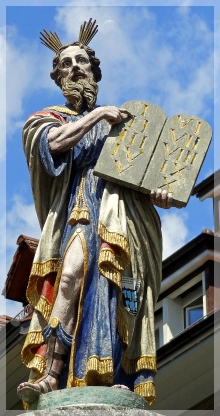
Moses Fountain - Bern  Although three places in Scripture tell us that the Lord proclaimed ten commandments and wrote them on stone tablets, those tablets weren’t numbered (especially not with Roman numerals)! The original languages of the Bible (Hebrew, Aramaic, and Greek) didn’t contain punctuation and the earliest manuscripts didn’t even have spaces between the words. While the words in Scripture are God-breathed, the punctuation was at the discretion of later copyists and translators. Without numbering, punctuation, or paragraphs, we can’t know for sure where one commandment ends and the other begins. As a result, while Jews, Roman Catholics, Protestants, and Orthodox Christians all observe the Ten Commandments, their commandments are not all the same!

For a Jew, rather than ten commandments, there are 613 throughout the Hebrew Scriptures. The first ten are called the Decalogue. While most Christians consider Exodus 20:2, “I am the Lord your God, who rescued you from the land of Egypt, the place of your slavery,” a preface to the Ten Commandments, it is the first one for a Jew and considered the most important because it establishes God’s authority for all that follows. Until that first commandment is accepted—that Adonai is one’s God—the rest wouldn’t be obeyed. The Jewish second commandment spans Exodus 20:3-6 and combines three prohibitions regarding idolatry: (1) no other gods, (2) no making of idols, and (3) no worship of idols. Commandments three through ten are the same as those recognized by most Protestants and Orthodox Christians.

Around 220 AD, the Christian Biblical scholar Origen of Alexandria numbered the commandments in the way familiar to most Protestant and Orthodox Christians. Skipping Exodus 20:2, He began with the prohibition of false gods “You shall have no other gods before me,” and continued with the second commandment prohibiting idols. The 10th commandment prohibited all coveting.

In the fifth century, however, Saint Augustine re-numbered the commandments so that the prohibitions about other gods and idols were combined into the first commandment. Making him short one commandment, Augustine then split Exodus 20:17 into two with coveting a neighbor’s wife the 9th commandment and coveting anything else of the neighbor’s the 10th. Although this required rearranging Scripture’s words, perhaps he reasoned that coveting your neighbor’s wife was vastly different than coveting his house or team of oxen. In any case, Augustine’s system was adopted by the church.

In 1054, the Christian church split into the Eastern Orthodox and the Roman. Orthodox Christians follow Origen’s numbering but include Exodus 20:2, “I am the Lord your God who rescued you from Egypt….,” in the first commandment. The Protestant Reformation of the 16th century further divided the church. Except for Lutherans, the Protestant church returned to Origen’s original numbering system. Perhaps because Luther was an Augustine monk for fourteen years, his version of the Commandments follows that of the Roman Catholic church with one notable exception. Returning to the original order found in Scripture, Luther’s 9th commandment prohibits coveting your neighbor’s house and the 10th prohibits coveting his wife, servant, animals, or anything else. In this way, Luther distinguished coveting the inanimate (house) from coveting the animate (wife, servant, etc.).

Who’s right? Only God know! Far more important than how the commandments are numbered, however, is what those commandments meant to the Israelites and what they mean to us today. The first three or four (depending on your denomination) have to do with mankind’s relationship to God and lay out our obligation to honor our Creator. The next seven or six (again depending on your denomination) have to do with the obligations we have to one another in family and society and lay out the foundation for building a community. Rather than disagreeing about how to number the Ten Commandments, we should make a greater effort to live the two spoken by Jesus!

Jesus replied, “‘You must love the Lord your God with all your heart, all your soul, and all your mind.’ This is the first and greatest commandment. A second is equally important: ‘Love your neighbor as yourself.’ The entire law and all the demands of the prophets are based on these two commandments.” [Matthew 22:37-40 (NLT)]

Copyright ©2024 jsjdevotions. All rights reserved.

AGE IS ONLY A NUMBER – Part 2

“Don’t be ridiculous!” Saul replied. “There’s no way you can fight this Philistine and possibly win! You’re only a boy, and he’s been a man of war since his youth.”… Goliath walked out toward David with his shield bearer ahead of him, sneering in contempt at this ruddy-faced boy. “Am I a dog,” he roared at David, “that you come at me with a stick?” [1 Samuel 17:33,41-43 (NLT)]

While reading about David and Goliath, I realized that it’s not just our seniors who can be undervalued or overlooked. It’s as wrong to disregard the youth in our midst as it is to discount the old. Likewise, just as some seniors may underestimate their gifts, the same could be said for those who still count the years rather than the decades! Age is just a number to God—He’s more interested in willing hearts than number of years!
As the youngest of his eight sons, Jesse took little notice of David and didn’t even include him in the feast when Samuel visited! God, however, doesn’t judge by appearances (or age) and it was the 10 to 15-year-old David who Samuel anointed king! When he faced Goliath, David was in his teens and Saul ridiculed him for thinking he could slay the giant. Like Saul, Goliath underestimated the young unarmed shepherd boy and the Philistine paid for it with his life!

Samuel was no more than 5 when he started serving Eli, the high priest and judge of Israel. He was about 12 when God tasked the boy with telling Eli that God’s judgment was coming upon him and his family. Most grown men wouldn’t have done that, but Samuel did and he continued serving God for the rest of his life.

Miriam was a young girl when she saved Moses’ life. It was her quick thinking that convinced Pharaoh’s daughter to hire their mother as his wet nurse. Saul’s son Jonathon was 20 when he and his armor bearer bravely attacked the Philistine camp and Jeremiah was less than 20 when God called him to be His prophet. While we picture Solomon as a wise old king, he was about 20 or less when he ascended the throne and sensibly asked God for that wisdom. Although Josiah was only 8 when crowned Judah’s king, Scripture tells us that he sought the Lord in all he did and showed more wisdom than far older kings.

Daniel, Shadrach, Meshach, and Abednego were between 13 and 20 when they courageously refused Nebuchadnezzar’s food so they could observe the dietary laws of the Torah and it was young Daniel who found the creative way of doing it. Having wisdom and understanding beyond their years, all four entered the king’s service in their teens and Daniel became chief of the king’s wise men. God began speaking to Joseph in prophetic dreams when he was 17, it was a young slave girl who directed Naaman to Elisha for healing, and Esther probably was 14 to 16 when she became queen of Persia.

Mary was no more than 16 when she accepted her role as the mother of God and Jesus was about 30 when he began his ministry. While we don’t know the disciples’ ages, we tend to picture them as mature men. Yet, a rabbi’s disciples usually were younger than their teacher so they probably ranged from no more than 30 to as young as 13—the age a boy usually became a rabbi’s disciple. When Christ was crucified three years later, they probably were between 16 and 33! Yet, those young men brought 3,000 to Jesus on Pentecost, formed a Christian community, preached in the Temple, spoke before the High Council, and defiantly continued to teach and preach that Jesus was the Messiah. Tradition holds that Timothy was about 16 when he became a Christ follower, under 20 when he joined Paul and Silas through Asia Minor, and probably in his mid-30s when he led the church in Ephesus. Youth didn’t deter the heroes found in Scripture!

Let us never make the mistake of writing off the young people in our midst just because of their age. Along with their amazing technical skills, they offer enthusiasm, energy, innovative methods, fresh insight, a “can do” attitude, and the ability to quickly learn new things. On the other hand, the younger generation shouldn’t discount their value because of their lack of years. God doesn’t care about age and neither should we! Let us all remember that it was a young boy’s offer of his meager lunch that saved the day and fed over 5,000!

Don’t let anyone think less of you because you are young. Be an example to all believers in what you say, in the way you live, in your love, your faith, and your purity. [1 Timothy 4:12 (NLT)]

“O Sovereign Lord,” I said, “I can’t speak for you! I’m too young!” The Lord replied, “Don’t say, ‘I’m too young,’ for you must go wherever I send you and say whatever I tell you.” [Jeremiah 1:6-7 (NLT)]

Copyright ©2024 jsjdevotions. All rights reserved.

AGE IS ONLY A NUMBER

I will sing to the Lord as long as I live. I will praise my God to my last breath! [Psalm 104:33 (NLT)]

English philosopher Francis Bacon defined “old age” as “always 15 years older than I am.” He would have liked it here in southwest Florida because there always seems to be someone fifteen years older. Nevertheless, having recently celebrated my 77th birthday, it’s getting increasingly hard to find them! While I enjoy being told I look good, I don’t like hearing the “for your age!” ending that sentence! Hearing that qualified compliment, being called “Hon” or “Sweetie” by a waitperson or nurse less than half my age, or people assuming my grey hair means I’m computer inept and/or hard of hearing remind me of the subtle ageism in today’s society.

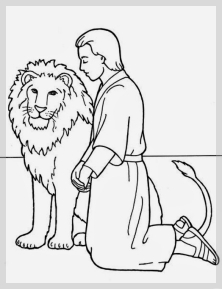
When I first learned about Daniel in the lion’s den in Sunday school, my teacher used a flannel board to tell the story and flannel Daniel had a full head of brown hair. The coloring page that accompanied Daniel’s story when my children attended Sunday school was of a strapping muscular youth. Even the illustrated Bible I gave my grand showed a powerfully built young man sitting amidst the lions. All of those portrayals were wrong! Nebuchadnezzar took only the strongest, healthiest, and best-looking young men for palace training. That however, was 605 BC. It wasn’t until 539 BC (during the reign of Darius the Mede) that Daniel was thrown into the lions’ den. By that time, he’d served as a government official for sixty-six years and probably was into his eighties! He’d lived among Gentiles in a pagan land for over six decades; nevertheless, even though he faced a gruesome death, he defied the king’s edict. Daniel went home, opened the windows, knelt down, and prayed to Jehovah as he’d done every day of his sixty-six-year captivity!

Daniel was an old man; then again, so was Abraham. He was 75 when God called him to leave his home, 86 when Ishmael was born, 99 when circumcised, and 100 when Isaac was born. Moses was 80 and Aaron 83 when they led the Israelites out of Egypt on what became a 40-year trek. Joshua was between 68 and 80 when he led Israel into the Promised Land and Caleb was 85 when he drove the Anakites from Hebron. Jeremiah ministered under Judah’s last five kings and was still prophesying until he was killed in his 70s. When he wrote his gospel and epistles, the Apostle John probably was in his mid to late 70s and, when he wrote Revelation, the man was well into his 80s. Sarah was 90 when pregnant with Isaac and the prophet Anna was over 100 when she recognized Jesus as the Messiah. While we may find ageism in today’s society but there is no such thing as ageism or retirement in God’s Kingdom! The younger ones in Christ’s church never must make the mistake of misjudging or undervaluing the seniors in their midst. I suspect the men who conspired against Daniel underestimated the power of an old man who trusted in God (a fatal mistake since they were the ones eaten by lions that day)!

On the other hand, those of us in our golden (but somewhat rusty) years must stop discounting our value, as well. That we’re facing some limitations or challenges due to age simply means it’s time to reevaluate, not to stop! As seniors, we provide strength, stability, encouragement, and wisdom to our younger brothers and sisters. No matter how old we are, we can always share God’s love and our prayers. God wasn’t finished with Daniel, Abraham, or Moses and He’s not finished with us!

Here is the test to find whether your mission on earth is finished: If you’re alive, it isn’t. [Richard Bach]

Now that I am old and gray, do not abandon me, O God. Let me proclaim your power to this new generation, your mighty miracles to all who come after me. [Psalm 71:18 (NLT)]

Copyright ©2024 jsjdevotions. All rights reserved.

JOTS AND TITTLES  (Matthew 5:18-19 – Part 1)

For verily I say unto you, Till heaven and earth pass, one jot or one tittle shall in no wise pass from the law, till all be fulfilled. Whosoever therefore shall break one of these least commandments, and shall teach men so, he shall be called the least in the kingdom of heaven: but whosoever shall do and teach them, the same shall be called great in the kingdom of heaven. [Matthew 5:18-19 (KJV)]

yod - jot and tittleWhat is a jot or a tittle? Found in the King James version, the words “jot” and “tittle” date from the 15th and 16th centuries. “Jot” comes from jota, an alternate spelling of the Greek iota (the smallest letter in the Greek alphabet) and, at the time, meant something very small. “Tittle” was a translation of keraia, a Greek word meaning “a little horn” that referred to an accent mark over a vowel. While those English words were good translations of the New Testament’s Greek, Jesus wasn’t speaking Greek when He gave the Sermon on the Mount. He was speaking Hebrew or Aramaic and the words He used weren’t iota and keraia.  He would have used yod, which was the smallest Hebrew letter, and kots, meaning thorn, which was the little curve or flourish at the yod’s top distinguishing it from other letters. The tenth letter of the Hebrew alphabet, yod sounds like a “y” and looks a bit like an apostrophe.

 21st century Gentiles might miss the deep impact of Jesus’ words but his 1st century Jewish listeners didn’t. When emphasizing the importance of even the most miniscule thing in life, a poplar Hebrew expression of Jesus’ day was, ”not a yod or a thorn (kots) of a yod.” As the first letter in God’s name (YHVH/Yahweh) and Israel (Yisrael), the yod had special significance to the people of Judah. Suspended in mid-air (like an apostrophe), the rabbis considered it to be the first dot with which a scribe started any other letter and its last dot when he finished. Being the smallest of the letters, the yod was considered the humblest. The oral tradition held that, because of its humility, the yod’s kots was added so to point to God.

According to Jewish tradition, when Solomon tried to remove the yod from the Torah, God told him a thousand Solomons would come and go before a single yod would be taken from Scripture. The rabbis held that should anyone take the yod from Scripture, their guilt would be so great that the world would be destroyed. There are about 66,420 yods in the Hebrew Bible but its little flourish was considered so important that, if even one kots was missing from a yod in a Torah scroll, the entire scroll was considered invalid and destroyed. The yod and kots meant a great deal more to Jesus’ listeners than do a jot and tittle or iota and dot mean to us.

By speaking of the significance of every yod and kots in the Law, it’s clear that Jesus had no doubt as to the divine inspiration of Scripture—down to what seem insignificant details like a kots on a yod. Nothing written in Scripture is unimportant because every letter came from God. Although the Pharisees frequently accused Jesus of disregarding the law, He said that not one letter of the law was insignificant. Not even the smallest flourish on the smallest letter would disappear until the Law was fulfilled!

Although usually translated as “verily” or “truly,” Jesus began His sentence with amén, a term of intense affirmation. While an amén at the end of a sentence confirmed the preceding words and invoked their fulfillment, an amén at the beginning of a sentence meant, “Pay attention! Something of utmost importance follows.” His amén affirmed both the truth of His words and His authority to say them.

Jesus’ words remain as valid today as they were 2,000 years ago. When we’re tempted to pick and choose only the verses we like in Scripture, let’s remember the importance of every jot and tittle in God’s word! Divinely inspired—not even the smallest letter in the smallest word is without significance.

And it is easier for heaven and earth to pass, than one tittle of the law to fail. [Luke 16:17 (KJV)]

Copyright ©2024 jsjdevotions. All rights reserved.