MORE THAN MEETS THE EYE

But you must not forget this one thing, dear friends: A day is like a thousand years to the Lord, and a thousand years is like a day. The Lord isn’t really being slow about his promise, as some people think. [2 Peter 3:8 (NLT)]

Along the road to the Serengeti, somewhere near the Olduvai Gorge in Tanzania, is a crescent-shaped sand dune. Measuring about 30-feet in height and 328-feet long along its curves, it is known as the Shifting Sands. Rich in iron and highly magnetized, the sand sticks to itself when tossed in the air. When the wind blows, its particles fall back on the dune rather than get carried away by the breeze. The dune, however, is constantly on the move as the prevailing winds slowly move the entire thing across the land. Moving about 50-feet a year, it’s believed that the Shifting Sands have been traveling the savannah for more than three thousand years, sometimes changing both shape and direction. Of course, the dune moves so gradually that you don’t see its motion. Nevertheless, stakes in the ground indicate its location in previous years.

Like the Shifting Sands, God often appears to be standing still. David was anointed king as a boy but he didn’t rule over all of Israel until he was 37 years old. After being promised a son, Abraham and Sarah waited 25 years before Isaac’s birth. It was 22 years between Joseph’s prophetic dream that his brothers would bow to him and the day they did! Think of the centuries that passed between God’s promise of Canaan to Abraham’s descendants and Israel’s arrival there. By the time Jesus was born, thousands of years had passed since God’s first promise of a Savior in Genesis 3, one thousand had passed since God’s promise in 2 Samuel that David’s line would continue eternally, and about 700 years had elapsed since the many Messianic prophecies found in Isaiah, Hosea, and Micah! God wasn’t quick but He made good on His promises—God always does!

God moves at His own pace—and it often seems undetectable at the time. Just because we don’t see Him move, however, doesn’t mean He’s standing idly by, forgotten His promises, or ignoring His children. God works in the unseen and just because we can’t see His hand at work doesn’t mean it isn’t happening! I never saw the Shifting Sands move and yet I know they moved 1½ to 3 inches the day I was there!

Like Tanzania’s moving dune, more is happening in God’s realm than meets our mortal eyes. As Christians, we must “live by believing and not by seeing,” and “walk by faith, not by sight.” [2 Corinthians 5:7] We live by believing in God’s promises—rather than what we think we see (or don’t see) in our world! God often seems incredibly slow but His time is not the same as ours and His perspective is far broader than ours! More is happening than meets the eye! God’s promises never fail and He always is right on time!

Faith shows the reality of what we hope for; it is the evidence of things we cannot see. [Hebrews 11:1 (NLT)]

So we don’t look at the troubles we can see now; rather, we fix our gaze on things that cannot be seen. For the things we see now will soon be gone, but the things we cannot see will last forever. [2 Corinthians 4:18 (NLT)]

Copyright ©2023 jsjdevotions. All rights reserved.

INCARNATION DAY

And the Word became flesh and dwelt among us, and we have seen his glory, glory as of the only Son from the Father, full of grace and truth. [John 1:14 (ESV)]

The Almighty appeared on earth as a helpless human baby, needing to be fed and changed and taught to talk like any other child. The more you think about it, the more staggering it gets. Nothing in fiction is so fantastic as this truth of the Incarnation. [J.I. Packer]

During the children’s Christmas program at our northern church, the tots would sing “Happy Birthday, Jesus!” by the manger and then return to their room to enjoy birthday cake. Like them, most people would say that Christmas commemorates the birthday of Jesus but that’s not quite correct. Jesus doesn’t really have a birthday! He was God and, as God, He always was, always is, and forever will be. Although Mary gave birth, “incarnation” is the more accurate term for what began in Nazareth nine months earlier and culminated in Bethlehem. Coming from the Latin incarnare, meaning to make flesh,” the word “incarnation” embodies the meaning of John 1:14: “the Word became flesh and dwelt among us.” Put simply, when Jesus came into the world, God the Son took on a human body and a human life like ours. The One who was there before the stars were hung in the sky, the One who was spirit and without physical body, came to earth clothed in human flesh.

When Jesus became incarnate, His nature changed but His position didn’t. He still was fully God and we see His “Godness” in His actions and words. He fulfilled over 350 Messianic prophecies—something no mere mortal could do. He was born of a virgin, had the authority to forgive, knew the future, stilled storms, healed miraculously, brought the dead back to life, and knew what was in people’s hearts. Jesus walked on water, cast out demons, and demons recognized Him. He accepted people’s worship (which would have been blasphemous were He not God) and He resurrected from the dead! Jesus claimed He fulfilled prophecies and existed before Abraham and said, “I am in the Father and the Father is in me.” [John 14:11] Indeed, Jesus was Immanuel—God with us!

Although Jesus was fully divine, at the same time, He also was fully human. He may have been conceived miraculously, but He developed in a woman’s womb like any other human baby. When Jesus entered the world through a birth canal, He took His first breath into his human lungs and cried like a baby. He grew into manhood the same way every other boy does—with skinned knees and bruises. Looking like any other Galilean of His day, Scripture tells us that Jesus ate, walked, spoke, read, listened, learned, and even paid His taxes. He wore clothing, went to the Temple, prayed, perspired, and bled. He grew thirsty and drank, grew tired and slept, was vulnerable to physical harm, experienced temptation, and could both touch and be touched. He experienced betrayal and abandonment and expressed human emotions like anger, joy, curiosity, sorrow, and disappointment. Even though He was fully God, Jesus chose to suffer as a man and die a mortal man’s physical death.

When Jesus became incarnate, He willingly gave up the majesty, glory, and divine attributes of God (apart from the direction of God the Father) to take on the limitations and pains of human life. He laid aside his “Godness” to live as a man with all the pain, discomfort, weakness, bodily functions, and limitations that accompany our bodies! Even though He wasn’t “born,” He was human in every way but one. Unlike every person since Adam and Eve, in spite of being tempted, Jesus managed to live a sinless life. He lived the life we should live (but can’t) and died the death we all deserve (but won’t receive). That’s what Christmas is all about!

Let us all celebrate the glorious day “the word became flesh” all year long!

The true light, which gives light to everyone, was coming into the world. He was in the world, and the world was made through him, yet the world did not know him. He came to his own, and his own people did not receive him. But to all who did receive him, who believed in his name, he gave the right to become children of God, who were born, not of blood nor of the will of the flesh nor of the will of man, but of God. [John 1:9-13 (ESV)]

Copyright ©2023 jsjdevotions. All rights reserved.

UNEXPECTED

For a child is born to us, a son is given to us. The government will rest on his shoulders. And he will be called: Wonderful Counselor, Mighty God, Everlasting Father, Prince of Peace. [Isaiah 9:6 (NLT)]

Come, thou long expected Jesus, born to set thy people free;
from our fears and sins release us, let us find our rest in thee.
Israel’s strength and consolation, hope of all the earth thou art;
dear desire of every nation, joy of every longing heart. [Charles Wesley]

I imagine the shepherds probably were more concerned with making it through the night warm, safe, and without losing any sheep than they were with the eventual arrival of the promised Messiah. They certainly never expected an angel to appear to announce His birth nor did they anticipate a host of angels singing God’s praises. Nevertheless, it was shepherds who received the good news that a child was born—a child who would be their Savior, Messiah, and Lord.

Shouldn’t this news have been given to the wealthy, powerful, or religious rather than a group of shepherds in a field?  Shepherds, especially those charged with the night watch, were among the lowest of the low. Considered disreputable, rough, dirty, ritually  unclean, and possibly dangerous, it hardly seems logical that outcast shepherds were the first ones to get Jesus’ birth announcement!

Then again, everything about the Christmas story is contrary to expectations. In fact, the Christmas story doesn’t even begin with Jesus; it begins with an angel, an old priest named Zechariah, his barren wife Elizabeth, a miraculous pregnancy, and a prophecy. When it finally gets to Jesus, we find an angel visiting the Galilean village of Nazareth, a place so insignificant that it’s not even mentioned in the Old Testament, Talmud, or even the historic writings of Josephus! It was hardly the hometown of a king! One would expect God to select a royal princess as the mother of His only Son instead of a young peasant girl. As a virgin, Mary certainly never expected a pregnancy before marriage nor did her fiancé Joseph.

Although Micah prophesied that the promised Messiah would be born in Bethlehem, Joseph and Mary were in Bethlehem only because of a census. When Mary’s time came, she gave birth to God’s Son in a borrowed stable, farm animals served as midwives, and the Prince of Peace lay in a feed trough instead of a splendid crib. Rather than royal courtiers, the King of Kings was surrounded by lowly shepherds and, instead of extravagant robes, the Lion of Judah was wrapped in rags. Other than the shepherds, it seems that the only people who took notice of Christ’s arrival were pagan astrologers from the East. Then, once the child’s presence became known to Herod, He was hunted instead of welcomed and His family fled in terror to Egypt! None of this fits the way we’d expect a Messiah’s story to go if we were writing it. Fortunately, we weren’t!

Yes, Messiah had been long expected but He came in a most unexpected way! None of this seems to makes sense until we understand that God didn’t come for the rich and mighty; He came for the poor and the lowly. He came for shepherds and lepers and the crippled, hungry, and poor. He came for the woman with the blood disorder, blind Bartimaeus, the woman caught in adultery, the Samaritan woman at the well, Mary Magdalene, and the Gentile demoniac in the Gerasenes. He came for tax-collectors like Zacchaeus and Matthew/Levi, zealots like Simon, and fishermen like Peter, John, James, and Andrew.  He came for the thief on the cross, the widow of Nain, Jarius and his daughter, the Syrophoenician woman and her daughter, and the Roman centurion. He even came for Pharisees like Nicodemus and rich council members like Joseph of Arimathea. Jesus came for people like you and me—the  ordinary, flawed, and sinful beings that we are.

The people of Judah expected a conquering king who would overthrow the Romans but what the world got was a King who overthrew Satan and conquered sin and death!

God never just meets our expectations; He surpasses them as only God can do! Thank you, God!

Born thy people to deliver, born a child and yet a King,
born to reign in us forever, now thy gracious kingdom bring.
By thine own eternal spirit rule in all our hearts alone;
by thine all sufficient merit, raise us to thy glorious throne. [Charles Wesley]

His government and its peace will never end. He will rule with fairness and justice from the throne of his ancestor David for all eternity. The passionate commitment of the Lord of Heaven’s Armies will make this happen! [Isaiah 9:7 (NLT)]

Copyright ©2023 jsjdevotions. All rights reserved.

OH COME, IMMANUEL (5) – THE SECOND ADVENT

The Lord of Heaven’s Armies says, “The day of judgment is coming, burning like a furnace. On that day the arrogant and the wicked will be burned up like straw. They will be consumed—roots, branches, and all. But for you who fear my name, the Sun of Righteousness will rise with healing in his wings. And you will go free, leaping with joy like calves let out to pasture. On the day when I act, you will tread upon the wicked as if they were dust under your feet,” says the Lord of Heaven’s Armies. [Malachi 4:1-3 (NLT)]

In the first Advent, Jesus came as a suffering servant in a manger. In His second Advent, Jesus will return in righteousness as the conquering King who makes all things right. His return means the final destruction of sin, injustice, hate, disease, death, decay and evil. Our God, however, is one of both mercy and judgement and Malachi’s promise of the Messiah included a warning about the coming day of judgment.

Jesus spoke of this coming judgment when He likened the division between believers and unbelievers to a shepherd who separates the sheep from the goats. True believers, however, don’t need to cower in fear at the prospect of judgment. Clothed in His righteousness, they will stand before Jesus forgiven of every single sin. As the faithful, they are the righteous sheep and destined for eternal life in the kingdom. The goats, however, are those who refuse to believe and they are destined for eternal punishment.

The early church thought Jesus would return within their lifetimes but 2,000 years have passed and He still hasn’t returned. Peter explained the delay: “A day is like a thousand years to the Lord, and a thousand years is like a day. The Lord isn’t really being slow about his promise, as some people think. No, he is being patient for your sake. He does not want anyone to be destroyed, but wants everyone to repent.” [2 Peter: 8-9]

Nevertheless, the day will come when Jesus returns to judge the living and the dead. He told us that we must be ready for that day. Just as a thief strikes an unsuspecting house by surprise, Jesus will catch an unbelieving world the same way. On that day, Almighty God will assess everyone according to their soul’s status and, when that happens, there will be no opportunity for last-minute repentance or bargaining.

It is in Christ’s return that we see the promises of God fully come to pass – promises to be with His people – promises that all things will be made new – promises of peace and security – promises of the full enjoyment of all that life was meant to be.

“God’s home is now among his people!” prophesied John in Revelation 21. “He will live with them, and they will be his people. God himself will be with them. He will wipe every tear from their eyes, and there will be no more death or sorrow or crying or pain. All these things are gone forever.” [21:3-4]

This season of Advent is more than a time of preparation to celebrate Christmas; it is a time of preparation to focus our hearts, wills, and minds on Christ’s return—not as the end of the world—but as the beginning of the life as God intended it to be lived—a time when peace and justice will prevail and there will be no death, sorrow, or tears.

2,000 years ago, the people of Judah longed for the promised Messiah and, recognizing mankind’s need for a savior, God answered their prayer with Jesus. As Christians in the 21st century, we long for Messiah’s return and, someday, God will make good on that promise, as well.

The question to ask ourselves during this season isn’t whether we’re ready for Christmas. The question we should be asking is whether we’re ready for that glorious day when Jesus returns.

“Men of Galilee,” they said, “why are you standing here staring into heaven? Jesus has been taken from you into heaven, but someday he will return from heaven in the same way you saw him go!” [Acts 1:11 (NLT)]

Don’t let your hearts be troubled. Trust in God, and trust also in me. There is more than enough room in my Father’s home. If this were not so, would I have told you that I am going to prepare a place for you? When everything is ready, I will come and get you, so that you will always be with me where I am. [John 14:1-3 (NLT)]

Copyright ©2023 jsjdevotions. All rights reserved.

OH COME, IMMANUEL (4) – HE WILL RETURN

As my vision continued that night, I saw someone like a son of man coming with the clouds of heaven. He approached the Ancient One and was led into his presence. He was given authority, honor, and sovereignty over all the nations of the world, so that people of every race and nation and language would obey him. His rule is eternal—it will never end. His kingdom will never be destroyed. [Daniel 7:13-14 (NLT)]

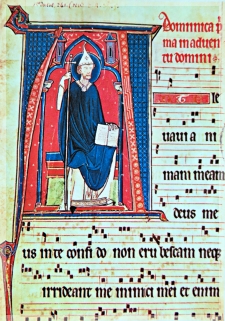
13th-century music manuscript

I began this series by saying that the Jews of the 1st century easily could have sung the words “O come, O come, Immanuel, and ransom captive Israel,” but those words weren’t sung by Jews. They were chanted in Latin over 1,200 years ago by Benedictine monks. In the 1800s, their words were translated into English, the verses rearranged, and the new version set to the melody of a 15th century French requiem mass processional.

The monk’s original version had seven verses and a verse a day was sung in the week before Christmas. Calling for God to come, each verse referred to a Messianic name found in the Hebrew Scriptures: Wisdom, Adonai (the Hebrew word for God), Root of Jesse, Key of David, Dayspring, King of the Gentiles, and Immanuel.

This Gregorian chant, however, was as much about the future as it was about the past. While celebrating our Savior’s birth, it also prepared the monks’ hearts for the day Jesus would return. You see, the first letter of each of the Latin names of God formed an acrostic. When put together in order, they spelled SARCORE but, when put together backwards, they spell Ero cras, which, in Latin, means “I shall be with you tomorrow.” While declaring the first Advent, this hymn is an urgent prayer expressing mankind’s longing for the second Advent when Jesus returns.

Scripture is neither vague nor equivocal on the promise of Christ’s return. His return is a major theme in the prophecy of both Old and New Testaments. 23 of the 27 New Testament books reference His return as do 17 books of the Hebrew Scriptures. According to Bible teacher David Jeremiah, references to Christ’s second coming outnumber references to His first by eight to one!

Jesus Himself promised His return. In Matthew 24:30-31, He spoke of a time people would, “see the Son of Man coming on the clouds of heaven with power and great glory. And he will send out his angels with the mighty blast of a trumpet, and they will gather his chosen ones from all over the world—from the farthest ends of the earth and heaven.”

On the night of His betrayal, Jesus promised His disciples, “I will come back and take you to be with me that you also may be where I am.” [John 14:3] After His ascension into heaven, two angels told the disciples, “This same Jesus, who has been taken from you into heaven, will come back in the same way you have seen him go into heaven.” [Acts 1:11]

Advent is far more than a time to look forward to celebrating Messiah’s birth and prepare for Christmas. It is as much a time to look forward to and prepare for Christ’s return! Many people missed His first coming but no one will miss His second!

And there will be strange signs in the sun, moon, and stars. And here on earth the nations will be in turmoil, perplexed by the roaring seas and strange tides. People will be terrified at what they see coming upon the earth, for the powers in the heavens will be shaken. Then everyone will see the Son of Man coming on a cloud with power and great glory. So when all these things begin to happen, stand and look up, for your salvation is near! [Luke 21:25-28 (NLT)]

Copyright ©2023 jsjdevotions. All rights reserved.

OH COME, IMMANUEL (3) – THE FIRST ADVENT

Listen! It’s the voice of someone shouting, “Clear the way through the wilderness for the Lord! Make a straight highway through the wasteland for our God! [Isaiah 40:3 (NLT)]

John the Baptist [Georg Pencz (1500-1550)]

Conquered and oppressed for centuries, the 1st century Jews were despondent. From its beginning in Genesis to its end in Malachi, their Scriptures were filled with prophecies of Israel’s deliverance and some 500 verses pointed to, described, or referenced the coming Messiah. Where was the descendant of David who would reward the righteous and punish the wicked? 1,000 years had passed since God’s covenant with David and 2,000 since His covenant with Abraham but God’s chosen people still weren’t free from their enemies and oppression. The Jews of Palestine easily could have sung the words, “Oh come, oh come, Immanuel, and ransom captive Israel.”  Where was he?

Where was the Messenger prophesied by both Malachi and Isaiah—the one who would prepare the way of the Lord and tell the towns of Judea. “Here is your God!”? And, where was the Messenger of the covenant?

The first Advent or coming of the Messiah occurred quietly the night Jesus was born in Bethlehem and only a few shepherds and some pagan astrologers took notice. When the first Messenger’s voice was heard, it was that of John the Baptist. Calling the people of Judah to repent, John told them the time of the promised “Messiah” was at hand. The promised Messiah, however, was not what the people expected.

Except for the 79 troubled years under the Hasmoneans, Judah had been governed by foreign Gentiles for over 600 years. It’s understandable that they longed for a king who would redeem them from foreign rule—a king who would sit on an earthly throne. But, with Jesus, the world got a king who redeemed them from sin and sits on a heavenly throne. Judah, however, wanted someone to liberate them from foreign rule, not sin! They were looking for the Lion of the tribe of Judah, not the Lamb of God and, because they expected a conqueror, they didn’t recognize the suffering servant God promised in Isaiah 53.

With that first advent or coming, God made a new covenant with His people—one prophesied in Jeremiah: “But this is the new covenant I will make with the people of Israel after those days…. I will put my instructions deep within them, and I will write them on their hearts. I will be their God, and they will be my people.…. And I will forgive their wickedness, and I will never again remember their sins.” [Jeremiah 31:33-34 (NLT)]

Jesus confirmed this new covenant while eating with His disciples in the upper room at His last Passover when, “He took a cup of wine and gave thanks to God for it. He gave it to them and said, ‘Each of you drink from it, for this is my blood, which confirms the covenant between God and his people. It is poured out as a sacrifice to forgive the sins of many.’” [Matthew 26:26-28]

In this new covenant, we receive the forgiveness of sins and God’s empowering Spirit to help us live lives full of self-giving (rather than self-serving) love. Jesus paid the ransom only God could pay and, by his death and resurrection, He freed us forever from Satan’s tyranny. Because the shedding of His blood paid our debt and purchased our forgiveness, we are secure as God’s adopted children. As the light of the world, Jesus banished hopelessness, rescued us from hell and unlocked the doors to heaven.

Our redemption only began when Jesus brought His light into the world. Death, disease, decay, and calamity remain and our enemy Satan continues to prowl. Jesus’ work is not finished and there still are Messianic prophecies to fulfill.

My servant grew up in the Lord’s presence like a tender green shoot, like a root in dry ground. There was nothing beautiful or majestic about his appearance, nothing to attract us to him. He was despised and rejected—a man of sorrows, acquainted with deepest grief. We turned our backs on him and looked the other way. He was despised, and we did not care. [Isaiah 53:2-3 (NLT)]

Copyright ©2023 jsjdevotions. All rights reserved.