BEWARE THE YEAST (Yeast – Part 2)

“Why can’t you understand that I’m not talking about bread? So again I say, ‘Beware of the yeast of the Pharisees and Sadducees.’” Then at last they understood that he wasn’t speaking about the yeast in bread, but about the deceptive teaching of the Pharisees and Sadducees. [Matthew 16:11-12 (NLT)]

oleanderFor a single-cell microorganism member of the fungus family, yeast is mighty powerful. When added to water and flour, it starts to grow and multiply as it ferments the sugars in the flour, releases carbon dioxide, and causes the dough to rise. Moreover, once added to something, yeast can’t be removed. When a small amount of old fermented dough called a starter or seor is kneaded into flour and water, it permeates the dough and makes it rise. Some of the newly leavened dough can be saved to become the starter for the next batch of bread and so on.

In the right conditions, yeast seems nearly immortal. San Francisco’s Boudin Bakery uses a sourdough starter originating in 1849.  Scientists even revived yeast microbes from 4,500 years ago to make a loaf of bread! Indeed, the longevity, growth potential, and pervasiveness of yeast makes it a powerful substance.

The way yeast permeates and affects the dough with which it is mixed certainly makes it a good metaphor for the influence of one thing on another. Even though the Hebrew Scriptures never equated leavening with sin or evil, leaven and corruption had become almost synonymous with one another by the 1st century. Although Jesus used yeast’s power in a positive way as a metaphor for the growth and spread of the Messianic Kingdom, He also used yeast in a negative way; just as good can influence the world around it, so can bad.

At various times, Jesus used yeast as a metaphor for the power of evil to spread. He warned the disciples about the yeast of skepticism and unbelief found in the Pharisees, Sadducees, and Herod. In spite of the bountiful evidence of Jesus’ true identity seen in His miracles, the Pharisees and Sadducees demanded yet another “sign from heaven” to prove His authority. When Jesus appeared before Herod, the king wanted to see the proof of His miracles, as well. Not wanting His followers to be infected with such distrust or thinking of His miracles as entertainment for unbelievers, Jesus made this warning several times. Taking Him literally at first, the disciples thought Jesus was speaking of bread until they finally understood His meaning.

Along with the Pharisee’s skepticism, Jesus didn’t want his disciples influenced by their addition of the Talmud’s oral traditions to God’s final word in the Hebrew Bible or their hypocrisy in meticulously following the letter of the law while ignoring the most important commandment—that of loving God and their neighbor. Jesus also didn’t want His disciples affected by the Sadducees’ deceptive teachings. More concerned with their ritual purity than people’s welfare and politics than religion, the Sadducees denied things like angels, heaven, hell, and the resurrection while believing that people’s souls died with their bodies. As for Herod’s evil influence—Jesus didn’t want His disciples influenced by the actions of this immoral and self-indulgent man.

In letters to the Corinthians and the Galatians, the Apostle Paul also used yeast as a metaphor for the powerful influence of erroneous thinking and sinful behavior. When the Corinthian church ignored the flagrant immorality of one of its members, Paul warned them to remove him from the congregation lest such immorality spread through the entire congregation (as yeast does when added to fresh dough). In the same way, Paul warned the Galatians about the danger of accepting the perverted gospels of both the Judaizers (who insisted Gentiles had to adhere to Jewish laws like circumcision) and the Legalists (who preached a doctrine of salvation by works). Such false teaching was dangerous because, like yeast, it spreads out and affects everything with which it comes into contact.

Be it even a little false doctrine or immorality (whether sexual sin or things like abuse of power, financial fraud, deception, decadence, hate, hypocrisy, or gossip), when such evil is tolerated by the Church, it is like yeast. It’s evil works invisibly and will permeate and influence all that it touches. Just as a little leaven leavens the whole lump, a little sin can destroy the individual as well as the Church—the body of Christ. Let us beware!
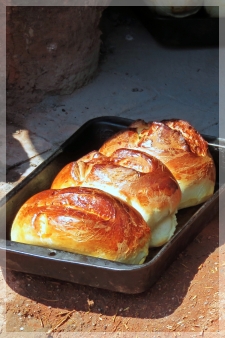
Don’t you realize that this sin is like a little yeast that spreads through the whole batch of dough? Get rid of the old “yeast” by removing this wicked person from among you. Then you will be like a fresh batch of dough made without yeast, which is what you really are. [1 Corinthians 5:6-7 (NLT)]

Copyright ©2023 jsjdevotions. All rights reserved.

YEAST AND THE KINGDOM (Yeast – Part 1)

Jesus also used this illustration: “The Kingdom of Heaven is like the yeast a woman used in making bread. Even though she put only a little yeast in three measures of flour, it permeated every part of the dough.” [Matthew 13:33 (NLT)]

Immediately after the Parable of the Mustard Seed, Jesus compared the Kingdom of Heaven to the yeast a woman added to “three measures of flour” when making bread. While “measures” seems vague, the original word used wasn’t. It was seah (about a peck and a half of flour) and three seahs were over 167 cups (nearly 50 pounds) of flour. This was an enormous amount of flour for just “a little yeast” and, as He did in the previous parable, Jesus used hyperbole to emphasize the power of something very small. The question in this parable is whether the yeast is a metaphor for a bad or a good thing.

This is the first mention of leavening in the New Testament but, by the 1st century, yeast had come to represent sin. Sticking to yeast’s traditional symbolism, some commentators liken the story’s yeast to false doctrine that can sneak into the Kingdom and see this parable as a warning about the dangerous power of false teaching in the Church. Enekrupsen is the Greek word used to describe the woman’s action in adding the yeast and this is its only use in Scripture. From egkruptó, which literally meant to bury within, enekrupsen has been translated with different meanings. Some translate it as hid or concealed (which implies she did something sneaky and devious in adding yeast) while others merely translate it as put, blended, or mixed in. Since enekrupsen is used both ways in other Greek literature, we can’t be sure which correctly communicates Jesus’ meaning. Considering that bread was being made, it seems that burying yeast in the dough would be expected rather than sneaky.

I find it hard to interpret this parable in a way that associates anything sinful or evil with the Kingdom of Heaven. Although His listeners may have expected yeast’s power to represent something bad, Jesus’ parables rarely fit his listeners’ expectations. When they anticipated one thing, He usually gave them another! That a Levite and priest had failed their fellow Jew while a hated Samaritan was the hero of one parable was as surprising as a beggar ending up in Abraham’s bosom at a heavenly banquet when the rich man ended up tormented in Hades. Jesus threw society’s expectations out the window when telling of a father who’d been offended and hurt by his wastrel son. Upon the boy’s return, rather than rejecting him as the law required, the father ran to welcome him home, restored him to the family, and even had a festive celebration in the boy’s honor. Equally unexpected was the story of vineyard workers getting the same pay regardless of how long they worked and the prayers of a tax collector being heard when the Pharisee’s were not.

I agree with the commentators who take this parable at face value. Believing Jesus simply is speaking of the pervasiveness and power of yeast, they see this analogy as a continuation of the lesson in the mustard seed parable. Rather than a corrupting influence, the leaven, like the mustard seed, illustrates that great things can come from small beginnings. Yeast is even smaller than the tiny mustard seed and yet both are powerful enough to expand and effect change. While both parables illustrate the extensive growth of the Kingdom, the second parable emphasizes the Kingdom’s transformative power. Just as yeast changes dough, the Kingdom will transform the world! In both parables, the message is clear—the Messianic Kingdom comes from small beginnings, operates quietly, but has the power to accomplish great things! That God’s Kingdom would start from small and humble beginnings to grow and change a much larger entity (the world) would have been reassuring news to Jesus’ small band of disciples.

Like the Kingdom of Heaven, yeast is a living organism. Like the Holy Spirit, yeast is invisible once in the dough and yet its effect, like that of the Spirit, becomes obvious as it permeates the mixture. Just as leavened dough grows from inside out, the Kingdom moves from our hearts into our actions and from our actions into the world. Yeast transforms what it mixes with and, as we are transformed, we transform those with whom we interact. Just as yeast needs certain conditions to grow, so does the Kingdom and, just as there are 1,500 different kinds of yeast, God’s Kingdom is made up of a wide assortment of people. Yeast is found everywhere—from the bottom of the ocean to the Arctic and from flower nectar to the lining of our stomachs—and God’s Kingdom should be as pervasive! Indeed, the Kingdom of Heaven is alive, it’s everywhere, it takes attention and patience to grow, and it transforms all it touches.

What Jesus’ listeners probably didn’t understand was that the Kingdom already had arrived. But, like a tiny mustard seed, a bit of yeast, or a baby in a manger, it entered the world quietly without fanfare. Like a small yellow flower, a lump of dough, or an itinerant rabbi from Nazareth, the Kingdom didn’t look that impressive at first. Appearances, however, can be misleading. Like a mustard seed that grows 1,440 times its original size or the more than fifty loaves of bread leavened by that bit of yeast, the Kingdom will increase and prevail. In the end, when Christ returns as a conquering king, no one will be able to miss its arrival. Until then, like a small amount of yeast, God’s Kingdom will transform the hearts and lives of all it touches! May we always remember that little things become great when God is at work!

When the dough is leavened, then to the oven with it; trials and afflictions commonly attend this change; but thus saints are fitted to be bread for our Master’s table. [Matthew Henry]

I will build my church, and all the powers of hell will not conquer it. [Matthew 16:18 (NLT)]

MUSTARD

black mustard - Brassica nigra
The Kingdom of Heaven is like a mustard seed planted in a field. It is the smallest of all seeds, but it becomes the largest of garden plants; it grows into a tree, and birds come and make nests in its branches. [Matthew 13:31-32 (NLT)]

Following the Parable of the Four Soils and the Parable of the Weeds, Jesus told a third parable of growth by comparing the Kingdom of Heaven to a mustard seed. I know little about farming and soil but I’m familiar with black mustard, (Brassica nigra), the kind of mustard grown in Palestine in Jesus’ day. Its clusters of bright yellow flowers are a common sight in the meadows, thickets, vacant lots, and fallow fields in my home state of Illinois.

Both times Jesus mentioned the mustard seed, He referred to its small size. When comparing the size of our faith to that of a mustard seed, He told us even if our faith were as small as a mustard seed that, “Nothing would be impossible.” When comparing the Kingdom of Heaven to a mustard seed, He called it the “smallest of all seeds.” Having admired the mustard seed charm my sister had on her bracelet, I questioned His statement. While it was small, I knew other seeds are even smaller. Surely the One who was there at creation’s beginning knew that the almost dust-like seeds of orchids and begonias are smaller. Additionally, while the mustard plant can grow as tall as 10 to 12 feet, it’s not a tree!

Jesus, however, wasn’t teaching botany, He was telling a parable and hyperbole (an exaggerated statement not taken literally that’s used to emphasize a point) was a common technique in rabbinic teaching. Jesus used it when speaking of recognizing a speck in our neighbor’s eye but not seeing the log in ours, Pharisees straining the gnats out of their water while drinking a camel, and trying to put a camel through a needle. When we look at the original Greek, however, we find less exaggeration. Jesus refers to the mustard seed as the smallest seed which a man sows in his field. While not the smallest seed in existence, mustard was the smallest seed that would have been sown in a Palestinian field. Jesus says it grows larger than a lachanōn (a garden herb or vegetable) and, indeed, black mustard does seem like a tree when compared to most herbs! That a seed measuring less than a tenth of an inch can grow 1,440 times its original size into a 12-foot plant in just one season is impressive and that was His point!

While most of America’s farmers consider this pervasive plant a noxious weed, it’s been cultivated as a crop for thousands of years in the Holy Land. Its seeds were powdered or made into a paste for medicinal and culinary purposes. Unlike most of us, Jesus’ listeners were familiar with mustard’s characteristics. As I describe those qualities, consider how they might apply to God’s Kingdom here on earth.

With its narrow clusters of small yellow flowers, mustard isn’t a showy flower—one might even call it a humble little thing. Nevertheless, a golden field of mustard is a thing of beauty. For a variety of scientific reasons, black mustard has a competitive advantage over most other plants. It’s one of the first plants to spring up after a fire and can out-compete anything else growing in the same field. It produces thousands of seeds every season and mustard’s long-lasting seeds can survive underground for as long as 50 years. An annual, while it dies at the end of a season, it regenerates at the next rainy season.

Although mustard was welcome as a cash crop in Palestine, because of its characteristics, black mustard is considered invasive in 44 of the 48 contiguous states. Nevertheless, in spite of the Midwest’s farmers’ persistent efforts to eradicate it, black mustard returns every year. Nature Collective describes it as “an ornery guest that refuses to take the hint.” In spite of persecution from Jewish leaders and Rome, the early church was just as defiant, determined, and persistent as black mustard!

Jesus’ listeners would have been familiar with the plant’s beauty and ability to self-seed, lay down a deep root system, and grow almost anywhere, along with mustard’s knack of surviving and thriving in less-than-ideal conditions. Jesus’ point was that from small and humble beginnings, the Kingdom of Heaven—Jesus’ domain as Messiah—would gradually grow into a large and beautiful entity. Once seeded, nothing seems to stop mustard and the same goes for the Kingdom!

May our faith be as persistent, hardy, determined, steadfast, and as difficult to destroy as the mustard seed!

“You don’t have enough faith,” Jesus told them. “I tell you the truth, if you had faith even as small as a mustard seed, you could say to this mountain, ‘Move from here to there,’ and it would move. Nothing would be impossible.” [Matthew 17:20 (NLT)]

Copyright ©2023 jsjdevotions. All rights reserved.