
Hear, O Israel: The Lord our God, the Lord is one. Love the Lord your God with all your heart and with all your soul and with all your strength. [Deuteronomy 6:4-5 (NIV)]
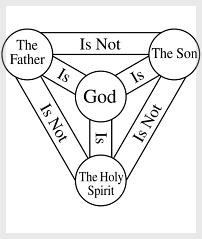
Deuteronomy 6:4-5 is the commandment cited by Jesus as the most important commandment of all [Mark 12:29-30]. It tells us there is one, and only one, God. Yet, as Christians, along with our belief in only one God, we profess our belief in the Trinity—the Father, Son, and Holy Spirit. How can that be?
Although we find a variety of names for God in Scripture, we never find the word “trinity.” Nevertheless, it appears in Christian doctrine. Then again, words like divinity, omniscience, incarnation, and omnipresent don’t appear in Scripture either. Nevertheless, like the Trinity, their concepts are found throughout Scripture. The absence of a word doesn’t invalidate a doctrine. While there is only one God, from the first words of Genesis to those in Revelation, we find a plurality to that one God—what we call the Trinity—consisting of the Father, Son, and Holy Spirit.
In Hebrew, the singular form of God is El, but when Genesis 1:1 says, “In the beginning God created the heavens and the earth,” the word translated as “God” is Elohim, which is the plural form of God. However, wherever we find the plural Elohim referring to God, the verb used is singular, which clearly implies only one God! In Genesis, we have God (Elohim) speaking of Himself in the plural saying, “Let us make man in our own image,” [1:26] and man “has become like one of us.” [3:22] God isn’t speaking to the angels because they are nothing like Him or us nor is God using a royal “we” since there are no other examples of its use in Scripture. In fact, the earliest evidence of royalty referring to themselves as “we” is not found until the 4th century!
The personages of God the Father, God the Son, and God the Holy Spirit are found in both the Old and New Testaments. In Genesis 14:18, we have the Father when El (the singular form of God) is used for “God Most High.” In Isaiah 7:14, we have the Son in Immanuel meaning “God with us.” In Job 33:4 and 37:10, we find the Holy Spirit as ruach el, meaning spirit or breath of God (el). In the New Testament, we have all three personages present when Jesus was baptized. God the Father (a voice out of the heavens) publicly proclaimed Him (Jesus) as His Son while the pneuma theou (Spirit of God) descended like a dove upon Him. [Matt 3:16-17] We have that same voice validating Jesus as God’s son in the Transfiguration. [Matt 17:5; Mark 9:7; Luke 9:35] Finally, we have Jesus putting all three persons together when He gave the disciples the Great Commission. [Matt 28:19]
Yesterday, Christians celebrated Pentecost, the day the Holy Spirit descended on Jesus’ followers. While Pentecost, like Christmas and Easter, celebrates an event, Christians will celebrate a vital part of our doctrine—the Holy Trinity—this next Sunday on what is called Trinity Sunday. While God the Father, God the Son (Jesus), and God the Holy Spirit have existed eternally as three distinct personages, there still is only one God! Our triune God was there in the Old Testament when Elohim decided to make man and our triune God was there when Elohim chose to save man in the New! While difficult to fathom and impossible to fully understand, this is one of the most important beliefs of our Christian faith. Thank you, God!
When I know it is the Word of God that declares the Trinity, that God has said so, I do not inquire how it can be true; I am content with the simple Word of God, let it harmonize with reason as it may. And every Christian should adopt the same course with respect to all the articles of our faith. [Martin Luther]

