
Then he withdrew from them about a stone’s throw, knelt down, and began to pray, “Father, if you are willing, take this cup away from me—nevertheless, not my will, but yours, be done.” Then an angel from heaven appeared to him, strengthening him. Being in anguish, he prayed more fervently, and his sweat became like drops of blood falling to the ground. [Luke 22:41-44 (CSB)]
I am never afraid of exaggeration, when I speak of what my Lord endured. All hell was distilled into that cup, of which our God and Savior Jesus Christ was made to drink. [Charles Spurgeon]
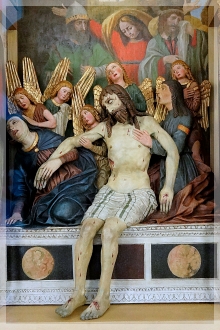 Although the common position for prayer was standing, Jesus fell to His knees that night in the garden of Gethsemane. Luke describes Him as praying so intensely that His sweat dropped like blood. Having used the word hósei, meaning “as if it were, like, as, as though, or much like,” Luke may have meant Jesus sweat so profusely that it dripped from Him like blood. Nevertheless, Luke was a doctor who paid great attention to detail; he may have described hematidrosis, a rare medical condition in which the capillaries rupture causing blood to seep into the sweat glands and then out onto the skin. It’s caused by high blood pressure, a bleeding disorder, or extreme distress or fear, such as facing abuse, torture or death on the cross! Whether Jesus’ sweat poured off his body as if it were blood or He literally sweat blood, the Lord’s prayer was so intense that an angel came and strengthened Him.
In Jesus’ prayer that Thursday night, we clearly see His two natures—that He was both fully human and fully divine. While the divine and human natures were united in Jesus, the two wills were not. As fully God, Jesus was in sync with His Father’s plan and walked willing to the cross to suffer and die, to bear our sins, and to redeem us from the gates of hell. On the other hand, Jesus also had a man’s will—a will like ours—one that could be tempted—a will that freely chooses whether or not to walk in obedience to God. We can be sure that Satan was attacking Jesus with false promises, doubt, and fear that night.
By beginning His prayer with, “Father, if you are willing,” Jesus acknowledged both His Father’s right to determine the answer to His prayer and His power to do so. Jesus then asked, “take this cup away from me.” The cup He wanted taken away was the horror that lay ahead for Him—not just suffering on the cross, but death itself. Fully man, Jesus must have trembled at what being the sacrificial lamb who bore the sins of the world would entail. As this fully human man grappled with being obedient to God’s horrific plan of torture and death, Jesus may have sweat real blood.
When Satan tempted another sinless man in another garden long ago, Adam said, “My will be done,” and sin entered the world. In Gethsemane, Satan tempted the second sinless man to say the same thing. Had the enemy been successful, the lamb of God would not have taken away the sins of the world. But, instead of saying “My will be done,” Jesus prayed these beautiful words: “Not my will, but yours, be done.” Like any man, Jesus would have preferred avoiding the physical, emotional, and spiritual agony awaiting Him; nevertheless, His words were ones of complete and unqualified submission to God’s will. Could we have done the same? Thank you, Jesus!
 Devotions of the Heart