
Enter by the narrow gate. For the gate is wide and the way is easy that leads to destruction, and those who enter by it are many. For the gate is narrow and the way is hard that leads to life, and those who find it are few. [Matthew 7:13-14 (ESV)]
 Like Christians, Hindus believe that, when the body dies, the soul does not. Unlike Christians, however, Hindus believe that, after death, the soul lives on in an astral body until it is reborn in another physical body. This cycle is continually repeated until the soul reaches a certain state of perfection (moksha) and is released from the bondage of birth and death. At that time, like a drop of water that eventually merges into the ocean, the soul will finally merge into God and become one with its creator. Of course, once absorbed by the sea, the drop would cease to exist.
Rather than being absorbed into the Supreme Being, when Christians die, their souls immediately enter into God’s presence and, at the resurrection of believers, their new bodies will be raised and reunited with their souls. Non-believers, however, do not end well and the parable of the rich man and Lazarus makes it clear that they don’t get to return to earth for another go-around. If there’s any doubt, Hebrews 9:27 tell us that, “each person is destined to die once and after that comes judgment.”
In spite of Hinduism’s belief in reincarnation and moksha, perhaps the biggest difference between my friend Esha’s religion and Christianity is that, while she finds Christianity a valid religion, as a Christian, I cannot say the same for Hinduism. Today, Esha used an analogy to explain the universalism of Hinduism. Just as we can get into Disney World from all directions and eight different entrances, she believes there are many equally acceptable routes and gateways to God. Instead of all roads leading to Rome, all roads lead to God. I respectfully disagreed but recalled her analogy later that day when sending a friend directions to my house.
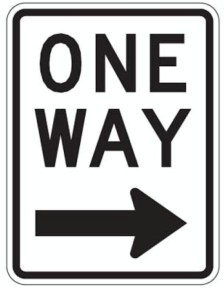
While people can come to my community from all directions, they can enter from only one road, must go in through one gate, and are required to have their name on a list to be admitted. That’s a little more like the one way and narrow gate of Christianity. Esha is correct that Disney World has several entrances, but Jesus made it clear that there only is one entrance into heaven and getting to that entrance depends on taking the right road. Fortunately, God allows U-turns. Just because we started on the wrong path doesn’t mean we have to end in the wrong place.
Nevertheless, there’s a sense of urgency in Jesus’ words in today’s verse. The verb form for the word translated as “enter” was what scholars call the “aorist imperative.” It was used for urgent, positive, one-time commands (which is why some translations say “stive to enter”). Jesus was emphatically telling people not to procrastinate or sight-see before getting on the right road. No one knows when their engine will fail or Jesus will return. While Hinduism maintains that people get multiple opportunities to do life right, Jesus tells us we have only one life in which to get on the right road!
All religions are not paths to the same end for the simple reason that religions with distinct mutually exclusive doctrines like Christianity, Hinduism, Buddhism, and Islam cannot all be valid! Either Jesus was right when He claimed to be the only path to God or He was wrong! While it sounds like spiritual elitism to say that Christianity is the only way, it’s more like simple arithmetic—there can’t be two right answers! Where there is contradiction, there is error.
Christ’s narrow gate has nothing to do with bigotry, discrimination, or a rating system of people or works. When it comes to entering His Kingdom, the gate isn’t wide enough to accommodate any other philosophy or belief; there’s no wiggle room. The narrow gate has one very specific requirement for entrance—faith in Jesus Christ! That’s the only way to get one’s name on the entrance list. With only one correct road, one narrow gate, and one Lord and Savior, Christianity is exclusive. Nevertheless, because the path to eternal life is open to anyone who asks and believes, Christianity is inclusive! All are invited; sadly, not all will enter.
Which way are you going? What road are you on?
Since no man is excluded from calling upon God, the gate of salvation is open to all. There is nothing else to hinder us from entering, but our own unbelief. [John Calvin]
 Devotions of the Heart