
There are three things that amaze me—no, four things that I don’t understand: how an eagle glides through the sky, how a snake slithers on a rock, how a ship navigates the ocean, how a man loves a woman. [Proverbs 30:18-19 (NLT)]
The world will never starve for want of wonders, but only for want of wonder. [G.K. Chesterton]
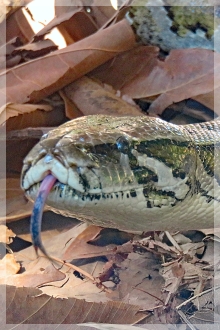 Recently, our pastor asked what amazed us. I thought of his question and Agur’s observation about snakes when we were at the zoo recently. I was amazed watching the 12-foot Burmese python effortlessly slither into the water. Her roommate, a 19-foot 200-pound reticulated python was equally amazing as he slowly unfolded and glided along the enclosure’s edge.
It wasn’t just snakes that amazed Agur; he was astonished at the way an eagle freely soars in the sky, a ship easily sails on the sea, and the way of a man with a woman. Although wise, Agur was at a loss to explain these wonders of nature. When looking for a common denominator, they all seem to have an invisible means of propulsion. The eagle soars in the sky while barely moving a wing, the legless snake simply glides over the rocks, a boat sails windward powered by nothing more than a piece of cloth, and something unseen draws a young man to a certain young woman like iron to a magnet.
Of course, we know there is a scientific explanation for each of these phenomena. By telling us about thermal and orographic updrafts, ornithologists explain how an eagle can precisely and effortlessly ride currents we cannot see and how the eagle’s large wingspan and slotted wingtips add lift and reduce drag. Agur, however, wasn’t an ornithologist.
Herpetologists explain that a snake’s ability to move forward lies in its belly scales. The ridges in between the snake’s underside scales function like the treads on the bottom of a boot—they can both get a grip on the ground and push off against it. As the snake glides across a rock, it creates traction and pushes off the ground in some parts of its body, while frictionlessly gliding forward in other parts. But, Agur wasn’t a herpetologist!
As for the physics of sailing, it has something to do with Bernoulli’s Principle—that the faster-moving air on the outside (windward) of a sail creates lower pressure, while the slower air on the sail’s inside creates higher pressure and the pressure difference (lift) is what pulls the sail and the boat forward. Meanwhile, the resistance of the keel in the water also generates lift and moves the boat forward. Agur, however, didn’t live in 1738 when Bernoulli published his principle!
Although scientists and researchers have spent decades trying to determine what draws a young man to a certain young woman, it still remains a mystery today. Although pheromones and scent play a role, attraction is a mysterious mix of physical, emotional, and social factors. Agur’s observation was spot on—we don’t know what causes a young man to love a young woman! As for love, I’m with the psalmist who said, “Such knowledge is too wonderful for me, too great for me to understand!” [139:6]
Agur didn’t fully understand these things and, truth be told, I still don’t fully understand thermals, traction, lift, and attraction—but I know the One who created them! Although the internet gives us access to a plethora of scientific information, we must never let all those facts rob us of our sense of wonder at all that God created. Knowing about things like Rayleigh scattering, the wavelengths of light, refraction, and reflection must never prevent us from being amazed at how God colors the sunrise and sunset or hangs a rainbow after a storm. I, for one, will continue to be amazed every time I visit the python enclosure at the zoo or see a rainbow in the sky! God gave us a world that defies explanation. Like Agur, a wise person knows that not everything can or need be explained to be appreciated!
What amazes you?
Never say there is nothing beautiful in the world anymore. There is always something to make you wonder in the shape of a tree, the trembling of a leaf. [Albert Schweitzer]

