
How happy is the one who does not walk in the advice of the wicked or stand in the pathway with sinners or sit in the company of mockers! Instead, his delight is in the Lord’s instruction, and he meditates on it day and night. He is like a tree planted beside flowing streams that bears its fruit in its season, and its leaf does not wither. Whatever he does prospers. [Psalm 1:1-3 (CSB]
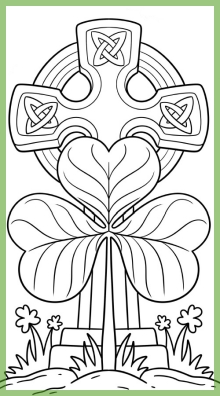 When we celebrate St. Patrick’s Day tomorrow, I suspect the revered bishop who brought Christianity to Ireland in the 5th century wouldn’t recognize this day in his honor. Originally a religious feast, it’s now a day for parades, sales, “Kiss Me I’m Irish” t-shirts, corned beef and cabbage, music, dancing, and lots of green (including hair, cookies, the Chicago River, milk shakes, and kegs of beer). St. Patrick, however, would recognize the common symbol of the day: the shamrock. Of course, to Patrick, the shamrock, with its three leaflets bound by a common stem, was a metaphor for the Holy Trinity. The shamrock’s three leaflets also came to symbolize faith, hope, and love.
“The luck of the Irish” may trace back to the thousands of superstitions in Irish folklore. (Getting married in May is bad luck but seeing a white horse in the morning is good!) The “lucky” four-leaf clover has its origins in ancient Celtic folklore. Irish and Celtic myths and legends also tell of fairies (Aes Sídhe) and pesky goblins (Púca) who were known to hand out both good and bad luck to humans. Nevertheless, it’s hard to see how a people who were invaded by Vikings, suppressed at the hand of England, suffered mass starvation during the Irish Potato Famine, failed at every revolution, and were treated like third class citizens upon their arrival in the U.S. could be called “lucky.”
According to Edwin T. O’Donnell of Holy Cross College, “the luck of the Irish” originally was a derogatory phrase here in the United States. During the silver and gold rush days of the 19th century, some of the most successful miners were Irish or Irish/American. Saying a miner’s success was “just the luck of the Irish” meant that it was mere happenstance and had nothing to do with the hours of drudgery the miner endured, the danger he faced, the sacrifices he made, the loneliness he suffered, or his skill with a pick and shovel.
Anne, a woman in my Bible study, mentioned her daughter’s recent school assignment. The girl and her parents were to paste pictures of the things that made them lucky on a large green construction paper shamrock. A woman of faith, Anne didn’t want to be one of those parents who make a mountain out of every molehill encountered in public school. Nevertheless, she credits God (not luck) with her family’s blessings, so she and her daughter pondered how to proceed with the assignment in a way that honors God. They pasted photos of their family on their “Lucky Family” shamrock and then wrote these words: “No luck involved! We are blessed by the grace of God to be a happy family!”
Attributing their happy family to luck would be as insulting to God as saying the success of a miner who’d struggled in difficult circumstances to stake his claim was just “the luck of the Irish.” Nevertheless, that construction paper shamrock with its three leaves also symbolizes what enables Anne’s family to live with joy, peace, forgiveness, and confidence: the Father, Son and Holy Spirit who govern and fill their lives. Moreover, the happiness of her family has to do with their faith, hope, and love (both for God and for one another). There was no “lucky” fourth leaflet on their shamrock because luck has nothing to do with it; God, however, does!
Don’t be deceived, my dear brothers and sisters. Every good and perfect gift is from above, coming down from the Father of lights, who does not change like shifting shadows. [James 1:16-17 (CSB)]
Copyright ©2026 jsjdevotions. All rights reserved.
 Devotions of the Heart