
“My kingdom isn’t the sort that grows in this world,” replied Jesus. “If my kingdom were from this world, my supporters would have fought, to stop me being handed over to the Judaeans. So then, my kingdom is not the sort that comes from here.” [John 18:36 (NTE)]
God’s kingdom, you see, isn’t about food and drink, but about justice, peace, and joy in the holy spirit. [Romans 14:17 (NTE)]
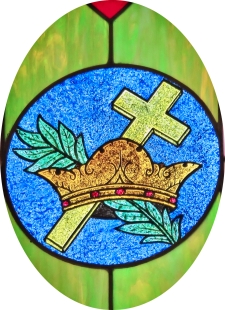 For those of us who attend liturgical churches, yesterday was the last Sunday of the liturgical (or church) year: Christ the King Sunday. A kind of liturgical “New Year’s Eve,” it is the climax and conclusion of the Church’s year.
Starting with Advent, the first half of the church year focuses on the events of Jesus’ life: His incarnation, birth, manifestation, temptation, suffering, death, resurrection, and ascension. The second half of the church year begins on Pentecost (with the outpouring of the Holy Spirit) and, depending on Easter’s date, lasts 23 to 28 Sundays. Sometimes called Ordinary Time, this season focuses on the teachings of Jesus. Next Sunday, we start a new year with the first Sunday in Advent and begin another journey through Scripture to remind us of who we are and to whom we belong.
Like the rest of the liturgical church calendar, Christ the King Sunday is man-made rather than ordained by God. Nevertheless, having attended a liturgical church most of my life, I find comfort in regularly celebrating not just Christmas and Easter but the entire mystery of Jesus—from His incarnation through His death, resurrection, and ascension, to the gifting of the Holy Spirit and the expectation of His glorious return.
When I first saw the words “Christ the King” on the church hymn board years ago, I didn’t know that this observance is a modern addition to the church year. It was instituted in 1925 by Pope Pius XI in response to the growth of communism, fascism, atheism, and secular ultra-nationalism in Europe at that time. Although first observed by the Roman Catholic church, Protestant denominations such as the Lutheran, Anglican, Moravian, Methodist, Nazarene, and Presbyterian churches have joined in observing this day as a reminder that Christ reigns above all earthly rulers.
In the past, cults of personality have formed around leaders like Mussolini, Hitler, Stalin, Mao Zedong, and they continue to form around some world leaders today. Christ the King Sunday is a vivid reminder that our allegiance belongs to our spiritual ruler in heaven as opposed to any earthly political “messiah.” While temporal powers will fade away, Christ’s reign and His kingdom remain eternal. Whether Roman Catholic, Orthodox, or Protestant, observing Christ the King helps to move us from the politics of people to the politics of heaven.
Indeed, Jesus is unlike any other head of state in history. While most leaders are concerned with gaining, increasing, and maintaining power, Jesus gave up His divine power to live as a man among the poor and humble and to die a criminal’s death. While the world’s “kings” strive to amass wealth; King Jesus deliberately left the grandeur of Heaven to be born in a stable and live in a small village as a carpenter’s son. Believing that might makes right, the world’s leaders use economic and military might to enforce their will but Jesus chose to love and forgive his enemies. Jesus’ kingly degrees are unlike those of any earthly ruler: love God, love our neighbors, do unto others as we would have them do to us, pray for our enemies, turn the other cheek, go the extra mile, live in peace with one another, and invite the poor, crippled, lame and blind to our banquets—hardly the typical political platform!
The Kingdom of God is a present reality in our lives and yet, at the same time, the completed Kingdom is yet to come. Theologians describe it as our living in the already—what Christ has done—and the not yet—what He is yet to do when He returns in majesty and glory. Until that day, however, there will be a struggle between the kingdoms of this world and God’s Kingdom. We might want to ask ourselves to which kingdom we owe our allegiance and evaluate whether our actions, attitudes, and words reflect that allegiance. May we always remember that Jesus is our only king; indeed, He is the King of Kings and Lord of Lords!
 Devotions of the Heart