
By now I could have lifted my hand and struck you and your people with a plague to wipe you off the face of the earth. But I have spared you for a purpose—to show you my power and to spread my fame throughout the earth. [Exodus 9:15-16 (NLT)]
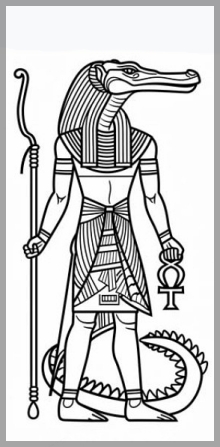 Over a period of 3,000 years, ancient Egypt’s pantheon of gods numbered between 1,400 and 2,000. During that time, some faded in prominence and new gods appeared. Often depicted as part human and part animal, Egypt’s gods had names, unique back-stories, and their own domain and expertise. Each god/goddess was responsible for a certain part of daily life, from motherhood to music, record keeping to funerals, and cosmic order to hunting. While the ten plagues God sent Egypt through Moses and Aaron may seem somewhat arbitrary to us in the 21st century, every one of them was a direct attack on one or more Egyptian god. They were the ultimate “smack-down” between God Almighty and Egypt’s deities.
When Moses struck the water of the Nile and turned it into blood for seven days, it was a direct attack on the crocodile-headed Sobeck, whose job was to be the Nile’s protector, as well as Khnum, the god of water and life, who was to guard the river’s source. The fouled river also was an affront to Osiris whose bloodstream was said to be the Nile. The plague of frogs who came up from the Nile and into people’s homes challenged the frog-headed goddess Heget who was in charge of regeneration, rebirth, and fertility. Aaron striking the dust of the earth to make gnats/fleas/lice immediately appear that covered both man and beast was a direct attack on Geb/Seb/Keb, the god of the earth and soil. The fourth plague, teems of flies or biting insects filling the air, challenged the power of Shu, the Egyptian god of air, and brought shame to any insect-headed god like Khepri whose head was that of a scarab beetle. With this affliction and the ones that followed, God distinguished between Egypt and the people of Israel. Remaining unaffected by the plagues, the people of Israel did not suffer these annoyances and hardships! While the God of Israel protected His people from the flies, Shu and Khepri couldn’t protect theirs!
The plagues intensified with the fifth plague, a deadly disease affecting cattle and livestock. The deaths of Egypt’s cattle was an insult to Apsis, the god of fertility (often represented as a bull) and the cow-headed Hathor, the goddess of love and protection. The punishment continued when ashes tossed by Moses became festering boils on both man and beast. This was the first direct strike on Egypt’s people and skin diseases and boils were seen as a sign of divine displeasure or judgment. Both Sekhmet, the goddess with power over disease, and Isis, goddess of healing, were helpless in the face of this challenge. The punishments increased with a devastating hail storm and continuous lightning, an attack on Seth/Set (god of wind and storms), Nut (goddess of the sky), and Osiris, the crop fertility god. The assault on those deities continued with the eighth plague, an east wind that blew in swarms of locusts. The false gods couldn’t prevent the locusts from consuming any vegetation that survived the hail storm.
The ninth punishment brought three days of complete darkness to the Egyptians. The most worshipped god in Egypt was the sun god Ra/Re, but both he and Kepri, the god of the dawn, were powerless in the face of Israel’s God. The final plague was death to the firstborn of both man and beast. Even Pharaoh’s son, believed to be a divine birth, died. These deaths challenged the power and authority of Isis and Osiris, the protectors of life, as well as Pharaoh, the god-king believed to be the son of Ra.
Revealing them as the powerless worthless idols they were, each of the plagues challenged, defeated, and shamed the false gods of Egypt. The God of Israel proved Himself to be the one true God—sovereign and superior in all aspects. While directed at Egypt, this message of Jehovah’s supremacy also was meant for the people of Israel as well as the rest of the world.
There is no need to go to heathen lands to find false gods. We can find them right here in our own country (and possibly in our own homes). Anything that gets between us and God is a false god and no more worthy of our devotion and worship than were Ra, Osiris, or Sekhmet. That we don’t depend on Seth to protect us from storms or bow down before statues of the bull-headed Apsis doesn’t mean we’re not guilty of idolatry! Nowadays, we worship the far more subtle false gods of the 21st century—things like wealth, power, influence, property, fame, pleasure, beauty, popularity, education, comfort, science, sex, money, and self. Never forget that our false gods will fail to serve and save us just as easily as Egypt’s false gods failed them!
What each one honors before all else, what before all things he admires and loves, this for him is God. [Origen]
 Devotions of the Heart