
Let us therefore no longer pass judgment on one another, but resolve instead never to put a stumbling block or hindrance in the way of another. [Romans 14:13 (NRSV)]
 Having witnessed Jesus’ God-like power over nature when He walked on water, the disciples recognized Him as “the Son of God!” [Mat 14:32] Recognizing Jesus’ divinity, however, did not mean they understood He was the Messiah. While Jesus’ power to heal, multiply food, still storms, and walk on water implied a godlike nature, most 1st century Jews didn’t expect the Messiah to be divine. Expecting a righteous judge and a great political and military leader coming from the lineage of David, they assumed he would be a human being. So, when Jesus asked His disciples who people thought He was, they said John the Baptist, Elijah, Jeremiah, or another one of the prophets—godly men who performed miracles, spoke of judgment, and called the people to return to covenant faithfulness.
Jesus then asked the men, “But who do you say I am?” With insight that came from God, Peter identified Jesus as “the Messiah, the Son of the living God.”[16:15] He understood that Jesus was both divine and the Messiah! Blessing the disciple, Jesus gave Simon (meaning “hearer”) the new name of Peter (meaning “rock”). When the disciple recognized Jesus as both the Messiah and “the Son of the living God,” the hearer became the foundation rock upon which the new church would be built.
Following Peter’s confession of faith, Jesus began to tell his disciples the implications of His Messiahship. He clearly described His suffering and death at the hands of the Jewish high court. Unfortunately, like the rest of the disciples, Peter believed the Messiah had come to provide economic and political relief for the Jews—not atone for our sins with His blood. Still thinking about an earthly kingdom, Peter took Jesus aside and said, “God forbid it, Lord! This must never happen to you.” [16:22]
It was then that Jesus addressed the rock as “Satan” and called him a “stumbling block.” In an instant, the man to whom Jesus gave the keys to the Kingdom and a name meaning rock had become a stumbling block and a tool for Satan! Like Satan’s temptations in the wilderness, Peter’s words tempted the Lord to thwart God’s plan and achieve greatness without suffering and death. Jesus roundly rebuked the disciple for wanting to put man’s plan ahead of God’s.
Hoping to protect Jesus from the suffering He’d predicted, Peter didn’t deliberately choose to be Satan’s tool. His error was in assessing the situation from his viewpoint rather than God’s. Having just proclaimed Jesus as the Son of the living God, Peter should have known that God had the situation firmly in control and that the only plan that mattered was God’s!
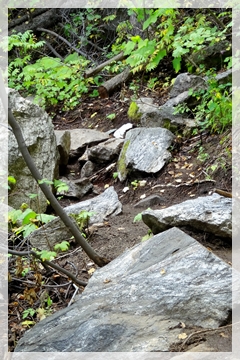
With Peter we see how easy it is to unwittingly move from being a rock to a stumbling block. Are we rocks—the solid people who can be relied upon, the ones who encourage, who can be trusted to hold things together, the firm foundations who support those who are weak and lift those who fall? Is ours a rock-solid faith that will follow God’s plan wherever it takes us? Or, like stumbling blocks—do we ever discourage, hinder progress, or cause doubt? Could our hypocrisy or less than stellar behavior hinder our witness? Even unintentionally, are we stumbling blocks that trip up the faith of those around us?
We know that wasn’t the last time the Apostle would disappoint the Lord. He wasn’t perfect and neither are we. Nevertheless, Peter proved to be the rock upon which Christ’s church was built. Like the Apostle, we too can be rocks that serve as stepping stones to further God’s purpose.
 Devotions of the Heart