
I urge you, first of all, to pray for all people. Ask God to help them; intercede on their behalf, and give thanks for them. [1 Timothy 2:1 (NLT)]
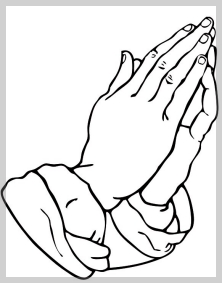 While there are no hard and fast rules about prayer except to believe in it and do it, some people use acronyms to help organize their prayers. The PRAY method stands for Praise, Repent, Ask, and Yield while the ACTS method formats prayer into Admiration (praise), Confession, Thanksgiving, and Supplication (asking God for what is needed). A TACOS prayer structure is Thanks, Adoration (or Applause), Confession, Others, and Self. Rather than an acronym, I was taught “The Hand of Prayer” as a girl. Beginning with the thumb, the order was Praise, Thanksgiving, Confession, Intercession (prayer for others), and Petition (prayer for oneself).
Regardless of how we do it, we should remember that only after we’ve put God first in our prayers, are we to pray for others and ourselves. I, for one, admit that I often speed through praise and thanks along with confession and repentance to get right to the asking. Worse, I find that my personal petitions frequently preempt and outweigh my intercessory prayers.
There is nothing wrong with praying for ourselves. In the Lord’s Prayer, we were taught to ask for our daily needs, forgiveness of sins, and deliverance from temptation. The Psalms are filled with pleas for God to intervene in the psalmists’ lives. Hannah, Jabez, David, Paul and even Jesus prayed for themselves. Praying for ourselves brings us into an intimate relationship with God and invites His blessings into our lives. The problem arises when we come to God just for those blessings without acknowledging Him or praying for others. Remembering our “God blesses” for others didn’t end with adulthood!
Before he became Pope Francis, Cardinal Bergoglio is said to have created the “Five Finger” prayer approach to help little ones remember their many “God blesses.” His method helps us remember to offer our prayers for others, as well. Because it’s nearest to the body when hands are folded in prayer, the thumb reminds us to pray for the people who are nearest and dearest—our family and friends. The index or pointing finger is a reminder to pray for those people (e.g. teachers, counselors, doctors, and pastors) who point us in the right direction. As the strongest and tallest, the middle finger is a prompt to pray for those in power and authority (even the ones with whom we disagree). Because it is the weakest digit with the least amount of dexterity, the fourth (or ring) finger reminds us to pray for the weak and powerless (e.g. the homeless, vulnerable, impoverished, and suffering). It is only when we get to the pinky that we pray for ourselves and our own needs. That little finger is a vivid reminder of how small we are in relation to God and how small our needs are in relation to the needs of others.
It is both a responsibility and a privilege to lift others’ needs to God in prayer. Abraham interceded for the people of Sodom, Job for his friends, Moses for the Israelites, the early church for the imprisoned Peter, Daniel for his captive nation, Paul for the readers of his letters, and Jesus for His disciples. John Calvin said, “To make intercession for men is the most powerful and practical way in which we can express our love for them.” When we pray with our five fingers, we have four fingers reminding us to do just that!
We are never more like Christ than in prayers of intercession. [Austin Phelps]
 Devotions of the Heart