
So the Word became human and made his home among us. He was full of unfailing love and faithfulness. And we have seen his glory, the glory of the Father’s one and only Son. [John 1:14 (NLT)]
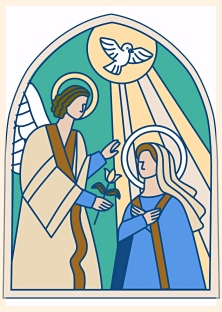
If we were living in England or any of its colonies between 1155 and 1752, today would be New Year’s Eve. Back then, the British Isles used the Julian calendar. Named after Julius Caesar, the calendar year originally began January 1. After the fall of the Roman Empire, however, the new year’s onset gradually changed to the first day of spring. While starting a new year in the dead of winter seemed counter-intuitive, beginning it on March 25, the date of both the spring equinox and the Christian Feast of the Annunciation of Christ’s Birth, seemed a more logical way to start the year.
The Julian calendar, however, miscalculated the adjustments needed for leap years as well as the date of the spring equinox. Wanting Christians to celebrate Easter on the correct date, Pope Gregory instituted a new liturgical calendar with a better way of calculating leap years in 1582. Called the Gregorian calendar, January 1 was set as the beginning of the year. While March 25 no longer marked the equinox, it remained the date of the Annunciation. Although much of Roman Catholic Europe adopted Gregory’s calendar, Protestant England resisted and continued to follow the Julian calendar until finally adopting the Gregorian one in 1752.
While no longer New Year’s Day, for those in liturgical churches, tomorrow (March 25) is known as the Annunciation of our Lord. Commemorating the angel Gabriel’s visit to the Virgin Mary, it is a celebration as much Protestant as it is Roman Catholic. The Annunciation was celebrated as far back as the fourth or fifth century and its March date was set in the seventh.
Let’s not forget that the story of Jesus didn’t begin in Bethlehem; it began in Nazareth nine months prior to that night. It was when Mary became pregnant that God became incarnate—a human being made of flesh and blood. Granted, He was only two cells fused together at first. Nevertheless, that zygote had everything in it to become the man Jesus. It divided again and again, the embryo grew, the cells began to differentiate, and the fetus developed everything needed to live outside His mother. Since sin-filled man was incapable of going to God, on that day, our perfect God came to us. Fully God and fully man—that baby boy forming in Mary’s womb was the promised Messiah and savior of mankind!
While Jesus’ incarnation is the core of our Christianity, it is difficult to understand and, for some people, impossible to believe. Nevertheless, the God who spoke the world into creation, created night and day, scattered the stars through the sky, filled the oceans with water, and populated the earth with living plants and animals could certainly manage to plant a fetus in a womb without going through the ordinary steps. When Mary assented to God’s will, Jesus was conceived through the power of the Holy Spirit!
Of course, since we really don’t know when Jesus’ birth took place, we don’t know the date of His conception. Nevertheless, having grown up in a liturgical church, I find a richness and strength in remembering and celebrating events in the life of Christ (even if the dates are wrong). Luke’s gospel account of Gabriel’s visit to Mary seems more appropriate in this spring season of new beginnings and fresh starts than in winter, a time of dormancy. On what I hope to be a beautiful spring day for you, please take the time to read the account of this blessed miracle found in Luke 1:28-36. Remember to thank God for His entry into the world as a man so that He could save humanity.
Jesus Christ became Incarnate for one purpose, to make a way back to God that man might stand before Him as He was created to do, the friend and lover of God Himself. [Oswald Chambers]
 Devotions of the Heart