
When Moses’ father-in-law saw all that Moses was doing for the people, he asked, “What are you really accomplishing here? Why are you trying to do all this alone while everyone stands around you from morning till evening?” [Exodus 18:14 (NLT)]
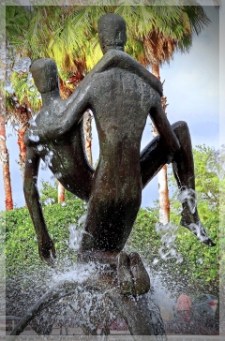 Back when I did weight training, I’d often find myself struggling with my last few reps. When I thought I couldn’t get the dumbbell up another inch and was about to give up, my trainer often gave me a little help so I could finish the rep. Disappointed that I couldn’t do it on my own, he’d remind me, “There’s nothing wrong with a little assisted lifting!”
Earlier this week, when writing about Israel’s victory against the army of Amalek at Rephidim, I didn’t tell the whole story. While Joshua and his men fought in the valley, Moses, Aaron, and Hur observed from a hilltop. Standing tall, Moses raised his arms and extended his staff for all to see. That staff was Israel’s banner and, as long as Moses kept the staff raised high in the air, the Israelites advanced. But, as the day wore on, the eighty-year-old began to tire. His arms grew heavy and, most likely, his back began aching and his legs started cramping. Whenever Moses’ fatigued arms started to fall, the Amalekites began to succeed. As the battle ebbed and flowed, its outcome seemed to depend as much on Moses and that raised staff as it did on the men’s skill with swords. Aaron and Hur, however, found a rock on which Moses could sit. Then the two men stood beside Moses and did some “assisted lifting” of their own by holding up his arms until Israel claimed victory at sunset.
Later, while still camped at Rephidim, Moses got another lesson in assisted lifting. From sunrise to sunset, he dealt with both the spiritual and interpersonal concerns of Israel. Scripture tells us there were 600,000 Israelite men. When we add women, children, and the “mixed multitude” that joined them in their escape from Egypt, more than two million people were traveling together. With those many people (described by Moses as “stiff-necked”), imagine the number of questions, concerns, grievances, and quarrels that came to his attention every day. When Jethro (Moses’ father-in-law) visited the Israelite camp, he observed his son-in-law’s demanding routine. Seeing how overwhelmed Moses was by his enormous responsibilities while others did nothing, Jethro warned Moses that working that way was unsustainable. He sagely advised him to delegate some of his duties among Israel’s leaders.
Jethro suggested that Moses continue to act as the people’s representative before God and as God’s voice to the people. As an intermediary between God and Israel, Moses would intercede for Israel and pass along God’s words to them. But, when it came to mediating people’s everyday (often petty) disputes with one another, Jethro suggested that Moses chose qualified men and subdivide the work of judging among them. Only the most difficult cases would come to Moses. After getting divine approval, Moses heeded his father-in-law’s advice and got some much-needed assisted lifting!
God doesn’t expect us to bear every burden alone. Moses couldn’t do it all by himself and, even though we often think we can, neither can we. Although God will provide assistance, his provision often comes in the advice and help we receive from others. Whether we take that help, however, is entirely up to us. Fortunately, Moses didn’t think himself too strong to be helped with his staff, too wise to be counseled by his father-in-law, or too indispensable to delegate work to others!
Rather than a barbell or even a shepherd’s staff, the heavy weight we’re asked to lift consists of the responsibilities, complications, predicaments, and challenges of life. At some time or another, like Moses, we all will need some assisted lifting. May we never be too proud to accept it.
Thank you, Lord, for the many ways you provide us with the assisted lifting that gives us the strength and ability to succeed.
 The Amalekites were a warlike nomadic tribe who frequently raided settlements to carry off plundered goods. About six weeks into the Israelites’ exodus from Egypt, these marauders made an unprovoked attack on the weary refugees while they camped at Rephidim. Moses commissioned Joshua to lead an army against their enemies the following morning. Joshua’s army, however, wasn’t made up of soldiers! Facing the veteran warriors of Amalek were men who less than two months earlier had been enslaved brick makers and field laborers! Worse, this unseasoned army was led by a general as inexperienced as were they. Nevertheless, Israel’s men set out to battle while Moses, his brother Aaron, and a man named Hur (who Jewish tradition believes was married to Miriam and brother-in-law to Moses) climbed to the top of a nearby hill to watch. As Israel fought their powerful foes, Moses extended his arms and held out his staff for all to see.
 Last week, after singing we’d come in the opening hymn, we promised to go in the closing one: I the Lord of Sea and Sky. Originally written for a Roman Catholic ordination mass in 1981, it has found its way into many Protestant hymnals. As I sang the refrain, “Here I am, Lord. Is it I, Lord?” I thought of Samuel and Isaiah, both of whom were called by God and both of whom responded by saying, “Here I am.” I wonder if I would have responded as positively as did they. Like Moses, would I have protested or, like Jeremiah, say my age disqualified me? Would I simply have run away as did Jonah? Although Moses, Jeremiah, and even Jonah eventually answered God’s call, I’m not so sure I would have (although three days in the belly of a fish might have convinced me)!
 Devotions of the Heart