
The wolf shall dwell with the lamb, and the leopard shall lie down with the young goat, and the calf and the lion and the fattened calf together; and a little child shall lead them. The cow and the bear shall graze; their young shall lie down together; and the lion shall eat straw like the ox. [Isaiah 11:6-7 (ESV)]
And one of the elders said to me, “Weep no more; behold, the Lion of the tribe of Judah, the Root of David, has conquered, so that he can open the scroll and its seven seals.” [Revelation 5:5 (ESV)]
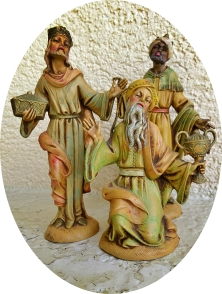 For centuries, access to the written Word of God was limited to just a few. The printing press wasn’t invented until 1439 and, at the time, only about 20% of the population could read. As a result, churches were decorated with paintings, stained glass windows, statues, carvings, and mosaics depicting biblical stories or illustrating theological concepts. For people who couldn’t read the book, religious art told the story. Consider how the Stations of the Cross in Roman Catholic churches illustrate the events of Good Friday. Sometimes, a picture really is worth a thousand words! While most nativity scenes are inaccurate, our depictions of the nativity don’t have to be historically exact to be meaningful.
At the Christmas market last week, an artist was painting a nativity scene. Having just written about the ox and ass found in depictions of Jesus’ birth, I was curious if he had them in his. Along with ox and ass, there was a lamb. The presence of this sacrificial animal is a vivid reminder that Jesus was the Lamb of God. It reminds us that His sacrifice on the cross is the reason for that baby in the manger.
But, front and center on the canvas, the artist painted a large lion looking down at the infant Jesus laying in a bed of hay. While not as common as the lamb, ass, and ox, the lion is no stranger to nativities. It points to Jacob’s promise to his son Judah that a conquering victorious king, the lion, would be from his line and suggests the words in Revelation 5:5 referring to Jesus as “the Lion of the tribe of Judah, the Root of David.” The lion’s presence also illustrates Isaiah’s prophecies of a time when God’s fallen creation will be remade into a place of peace, harmony, and order—a time when Christ will reign over all the earth—when a lion will eat straw rather than babies in a manger!
Although they didn’t arrive until Jesus was a toddler, we also find the magi in most nativities. Rather than kings, the magi probably were scholars or priests knowledgeable in astronomy and astrology. It may have been the extravagance of their gifts that caused them to be portrayed as royalty. Moreover, kings presenting gifts to the Messiah echo the prophecies of Isaiah 60 and Psalm 72.
While three gifts were presented, Scripture doesn’t say how many magi there were. Nevertheless, we see three. One king usually is depicted as a Black African, another as Caucasian, and the third as Asian. In Jesus’ day, there were three known continents—Africa, Asia, and Europe. In the 700s, the Venerable Bede (theologian and historian) posited that each of the magi represented one of those parts. As inaccurate as their depictions may be, their different races beautifully illustrate that Jesus came for the people of all nations and races. Seeing the kings of the world bowing in humble worship to the King of Kings, we are reminded that earthly kingdoms may fall but God’s Kingdom will not be destroyed!
In sharp contrast to a nativity’s richly attired kings are the often-barefoot shepherds in their simple attire. While kings were at the top rung of the social ladder, shepherds (along with taxmen and lepers) were at the bottom. The presence of both groups around the manger reinforces the unity that all people (both rich and poor) have in Christ! One shepherd often stands out from the others—a tall shepherd carrying a lamb on his shoulders. His presence is a subtle reference to Jesus as the “good shepherd” who will go to great lengths to save His flock.
Take time this holiday season to look at the various renditions of the nativity around you. Instead of looking for historical accuracy, try to find the scriptural and theological themes hidden within the art. Indeed, sometimes a picture is worth a thousand words!
 Devotions of the Heart