
The ox knows its owner, and the donkey its master’s crib, but Israel does not know, my people do not understand. [Isaiah 1:3 (ESV)]
Here betwixt ass and oxen mild, sleep, sleep, sleep, my little child… [13th century French carol]
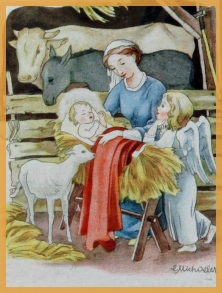 The earliest known portrayal of Jesus’ birth is a bas relief on a Roman sarcophagus from around 385. It depicts the swaddled Christ child in the manger flanked by an ox at His head and an ass at His feet. Why are they present instead of Joseph and Mary? In 1223, Francis of Assisi brought some hay and a manger to a cave and celebrated Mass there on Christmas Eve. Even though Mary and Joseph weren’t present, an ass and an ox were! In 1291, Pope Nicholas IV commissioned Arnolfo di Cambio to create a permanent nativity. While there are statues of Mary and Jesus, Joseph, and three Magi, the sixth statue shows the heads of an ox and an ass rather than shepherd or angel. Besides the baby Jesus, the ass and the ox are the most ancient and consistent elements in depictions of the nativity. Why do these two animals, neither of which is mentioned in the gospels, have such a prominent place in our nativity scenes, Christmas cards, and carols?
In Scripture, the ox came to represent the people of Israel. As the most important and costly of sacrificial animals, the ox also represented Israel’s prosperity and power. In the temple, figures of twelve oxen (representing Israel’s twelve tribes) supported the huge bronze basin that held water for ritual cleansing. While the ox was considered a ritually “clean” animal, the undivided hoof of the donkey (or ass) made it “unclean” so it came to represent the pagan Gentile nations. Deuteronomy 22:10 specifically prohibited plowing with an ox and an ass yoked together. Jews interpreted this law as being about more than plowing—it was about not mixing the clean with the unclean or the Jew with the Gentile.
In the 8th century BC, Isaiah prophesied, “The ox knows its owner, and the donkey its master’s crib, but Israel does not know, my people do not understand.” At the time, he was bringing God’s charges against Judah and speaking of God’s judgment against them in the immediate future through Assyria and also God’s later judgement with Babylon’s invasion and the fall of Jerusalem. Dumb animals knew to whom they belonged, but God’s chosen people did not!
With the benefit of hindsight, however, the early Church fathers recognized a third prophecy in Isaiah’s words—that of the Messiah’s arrival when Israel failed to recognize Him. Like the donkey, however, the Gentiles knew their master’s crib. Because the ox and ass recognized the Christ when the world did not, they are shown with the Christ. This image illustrates Paul’s words to the Ephesians that Jews and Gentiles are reconciled and have become one in Christ. Their presence at the nativity became a visual way of saying that Jesus came to save the people of all nations!
Because the firstborn male was the Lord’s, Mosaic law demanded the sacrifice to God of every firstborn male of the people’s livestock. As a ritually clean animal, the ox was an acceptable sacrifice. As an unclean animal, however, the ass could not enter the temple or be offered to God. A law unique to the ass gave its owner a choice—rather than killing such a valuable animal, he could redeem it with the sacrifice of a lamb. We sinners, like the ass, are unclean and cannot enter God’s tabernacle but, like the ass, our owner can redeem us with the sacrifice of an innocent lamb, which He did! We are redeemed by the blood of Jesus, the Lamb of God.
While seeing an ox and ass on Christmas cards or in nativity scenes may not be an accurate representation of that first Christmas, let us remember the symbolism behind their presence. While we may be as different as an ox is from an ass, Christ’s church is made up of one united people—people who have been redeemed by the blood of the Lamb!
There were only a few shepherds at the first Bethlehem. The ox and the donkey understood more of the first Christmas than the high priests in Jerusalem. And it is the same today. [Thomas Merton]
 Devotions of the Heart