
Don’t misunderstand why I have come. I did not come to abolish the law of Moses or the writings of the prophets. No, I came to accomplish their purpose. I tell you the truth, until heaven and earth disappear, not even the smallest detail of God’s law will disappear until its purpose is achieved. [Matthew 5:17-18 (NLT)]
You search the Scriptures because you think they give you eternal life. But the Scriptures point to me! [John 5:39 (NLT)]
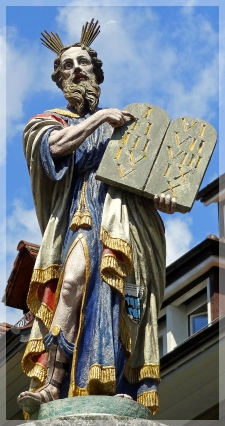 Our Colorado church had a large worship center with excellent acoustics so, when the local Jewish congregation wanted to present a concert of Jewish music by a well-known Jewish performer, we were happy to offer our venue to them. The Christians in attendance never expected the evening to end with Jews and Christians joining hands and dancing the hora around the church while singing “Hava Nagilah” (Let Us Rejoice). What the Jews hadn’t expected were the Bibles on the back of every chair. Before the concert began, many intently looked through them and, after the concert, they expressed their surprise at finding their Hebrew Scriptures in our Christian Bibles!
While we call it the Old Testament, it isn’t called that by a Jew. When “testament” appears in the New Testament, it is a rendering of the Greek word diatheke, meaning covenant. While Christians recognize the old covenant God made with the Israelites, we also believe He made a new covenant (or testament) with the followers of Jesus. For a Jew, however, there’s nothing “old” about that covenant because there hasn’t been a new one. As a result, they much prefer the term Hebrew Bible or Hebrew Scriptures. The other term used for the Hebrew Bible is Tanakh—an acronym for its three categories: Torah (Law), Nevi’im (Prophets), and Ketuvim (Writings).
Even though the Hebrew Bible has 24 books divided into those three categories and our Old Testament has 39 books and four categories (Law, History, Wisdom and Poetry, and Prophecy), they both tell the same story, but in a different order. The number of books differs because the Hebrew Bible combines the first and second books of Samuel, Kings, and Chronicles, the books of Ezra and Nehemiah, and the 12 books of the minor prophets. Instead of ending with the Prophets as does our Old Testament, the Hebrew Bible ends with the Writings and the book of Chronicles.
The 1st century Jewish historian Flavius Josephus (37/38 – 100 AD) reported that there was an authoritative list of the twenty-two books Jews called “holy scriptures” that was determined by the time of Artaxerxes (464-424 BC). The book number differs because Ruth was attached to Judges and Lamentations to Jeremiah at that time. We know that the Scripture our Lord read, studied, and memorized as a boy in Galilee is the same Scripture we have today.
Jesus made frequent references to the Scriptures throughout His ministry and his enemies soon learned that they couldn’t argue the Word of God with the One who breathed that word! He defeated Satan’s temptations with words from Deuteronomy and, during his frequent confrontations with the Jewish rulers, Pharisees, and Sadducees, He made specific references to verses in Genesis, Leviticus, Deuteronomy, Exodus, Samuel, Isaiah, Hosea, and Psalms. He quoted from Malachi when speaking of John the Baptist and frequently quoted from Scripture to show how He would fulfill prophecies. He explained the writings of Moses and the prophets to Cleopas on the road to Emmaus. According to Liberty University’s Harold Willmington, of the 1,800 verses reporting Jesus’ words in the gospels, 180 verses are Old Testament quotes or allusions.
While I can understand a Jew’s unfamiliarity with a Christian Bible and surprise at finding the Hebrew Scriptures in it, I can’t understand why those of us who claim to follow Jesus are so unfamiliar with the words our Lord read, studied, quoted, and believed while He walked the earth! If it was important to Him, shouldn’t it be important to us?
 Devotions of the Heart