
Yea, though I walk through the valley of the shadow of death, I will fear no evil: for thou art with me; thy rod and thy staff they comfort me. [Psalm 23:4 (KJV)]
 In Psalm 23, the King James version translates the original Hebrew “gay tsalmaveth” as “valley of the shadow of death.” A more accurate translation, however, would be a dark valley or a valley of death-like darkness. While people often associate this psalm with death, it uses the metaphor of sheep and their shepherd and sheep have no concept of death. But, because of their near-sightedness and poor depth perception, they are reluctant to move into dark places. Nevertheless, whether referring to the unknown, danger, or even death, David’s words are ones of comfort and hope to all who read them—we are not alone as we travel through the dark valleys of life.
My friend Joe recently told me about his sister’s final hour after a long and grueling battle with cancer. As Joe sat on the bed beside the dying woman, she suddenly sat up and stared ahead at a painting on the opposite wall. When he asked what had her attention, she replied with a question of her own: “Don’t you see?” Looking at the picture, all he saw was a landscape with trees, rolling hills, and a few birds high in the sky. “What?” he asked his sister as she kept her eyes straight ahead. “Him! Don’t you see Him?” When Joe asked who, she said it was Jesus, adding, “He’s smiling at me.” Smiling herself, his sister lay back against her pillow, closed her eyes, and died within the hour. Since that day, Joe has looked at that picture many times and can find nothing that even resembles a person, let alone Jesus. I suggested that, rather than seeing something in the painting, his sister was seeing someone in front of the painting—the good shepherd who would accompany her through the dark valley into the light.
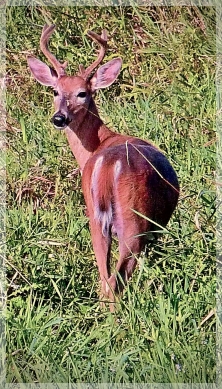
My friend Carol’s Uncle Stan was an avid outdoorsman and lover of nature. Having been defeated by heart disease, Stan’s hospital bed was placed by the picture window in his Northwoods home. Shortly before his passing, a three-point buck emerged from the woods and slowly approached the house. The magnificent creature stood by the window and seemed to stare in at him. Eventually, the buck lay down beneath the window and, like the rest of Stan’s family, kept the man company for the next few hours until he peacefully passed into God’s arms. Carol believes the buck’s presence was God’s way of comforting Stan as he took his final journey.
Death is inevitable and as much a part of life as birth; as Christians, we have no reason to fear it. Nevertheless, we still face the end of life with some trepidation. After all, it is our final surrender. Even though Scripture assures us that death takes us home to the Lord, the moment of death remains a mystery. Will there be a flash of light, a heavenly chorus, or a dark tunnel? Lazarus didn’t say and neither Trip Advisor nor Yelp have posted any reviews. I suspect it is both the most terrible and yet the most beautiful moment of our lives. Let us take comfort from the encouraging words of the 23rd Psalm that we are under God’s care and safe in His presence when we enter any shadowy valley—even the valley of death.
Was the buck’s extraordinary visit just a coincidence or was it a gift from God? Did Joe’s sister see Jesus or was it the hallucination of a dying woman on opioids? We’ll never know. I tend to think it was God’s way of assuring both of those dying believers (and their families) that they would not be making their final journey through that dark valley alone. The good shepherd was right beside them.
Death is not the end of the road; it is only a bend in the road. The road winds only through those paths through which Christ Himself has gone. This Travel Agent does not expect us to discover the trail for ourselves. Often, we say that Christ will meet us on the other side. That is true, of course, but misleading. Let us never forget that He walks with us on this side of the curtain and then guides us through the opening. We will meet Him there, because we have met Him here. [Erwin Lutzer]
 Devotions of the Heart