
The land produced vegetation—all sorts of seed-bearing plants, and trees with seed-bearing fruit. Their seeds produced plants and trees of the same kind. And God saw that it was good. [Genesis 1:12 (NLT)]
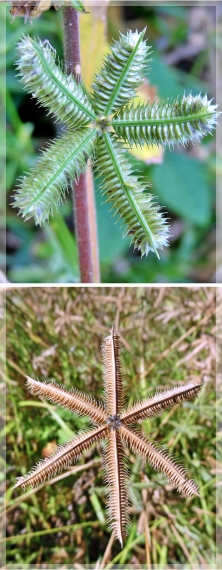 When I saw a wildflower that looked like a helicopter’s rotors, I showed it to the park’s naturalist for identification. Not as impressive as Scarlet Hibiscus or as colorful as Butterfly Weed, she found the plant unworthy of name or notice and wrote it off as “just a weed!” What some people call “weeds,” I think of as wildflowers and a little research told me it was the floret of Egyptian Crowfoot Grass (Dactyloctenium aegyptium). Native to Africa and widely distributed throughout the tropics and subtropics, it is one of the most drought-resistant of grasses.
While Crowfoot Grass may be a weed to some people, it is relished by ruminants like sheep, cattle, deer, and their relatives. Suitable for silage, it makes valuable pasture, excellent hay, and its seeds are fed to poultry. The plant material is used for making paper and weaving mats and baskets. In traditional African and Asian folk medicine, decoctions of its seeds have diuretic, anti-inflammatory, analgesic, antipyretic, and antibacterial effects. Its highly nutritious seeds make it a “famine food” and, when food is scarce, those seeds are used to make porridge and cakes that can sustain people’s lives in times of need.
Ralph Waldo Emerson described a weed as “a plant whose virtues have not yet been discovered,” and the naturalist’s quick dismissal of the Crowfoot Grass was because she didn’t appreciate its unseen qualities. Nevertheless, some of God’s best work is evident in His unusual and underrated “weeds” and the same might be said about their human equivalents. Like the unimpressive and humble Crowfoot Grass, God’s prophets were out of the ordinary, overlooked, unappreciated, and rebuffed by many. Nevertheless, even though they were disregarded and disparaged as if they were weeds in a rose garden, they continued in faithful obedience to God.
Like Crowfoot Grass, Jesus didn’t meet people’s expectations or conform to the norm. To Pilate, Herod, Judah’s religious leaders, Rome, and many others in 1st century Palestine, Jesus was little more than a troublesome weed that needed to be eradicated. Appearances, however, are deceiving—that unpretentious weed was the Son of God, the Prince of Peace, and (like Crowfoot Grass) the Bread of Life!
Crowfoot Grass doesn’t look like much but appearances are deceiving. Just as the naturalist dismissed it as “just a weed,” I wonder if I ever do the same with people! Judging by appearance, do I fail to take the time to discover their hidden virtues? After all, a weed is simply a flower in disguise! Let’s never make the error of failing to look beneath the surface to appreciate the value and beauty of both the plants and people we encounter in God’s garden.
There is not a flower that opens, not a seed that falls into the ground, and not an ear of wheat that nods on the end of its stalk in the wind that does not preach and proclaim the greatness and the mercy of God to the whole world. [Thomas Merton]
 Devotions of the Heart