
Don’t let down your guard lest even now, today, someone—man or woman, clan or tribe—gets sidetracked from God, our God, and gets involved with the no-gods of the nations; lest some poisonous weed sprout and spread among you, a person who hears the words of the Covenant-oath but exempts himself, thinking, “I’ll live just the way I please, thank you,” and ends up ruining life for everybody. [Deuteronomy 29:18-19 (MSG)]
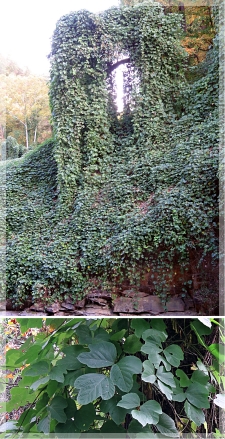 Last month we took a driving trip through Virginia and North Carolina to enjoy the fall colors in the Blue Ridge and Smoky Mountains. While taking a train ride along the Nantahala River Gorge, we commented on the beautiful vines covering the hillside. Our seat-mate told us this lovely looking plant is a destructive weed called kudzu. Native to Asia, this semi-woody vine was introduced to the U.S. back in 1876 during the Philadelphia Centennial Exposition. Originally advertised as an ornamental plant, kudzu’s ability to grow up to a foot day (and up to 60-feet a year), overtake, grow over, and smother just about anything in its path, has given it a new name: “the vine that ate the South.”
Thinking that kudzu would revitalize the land, reduce erosion, and add nitrogen to the soil, the government once offered up to $8 per acre as incentive for farmers to plant it. Giving no thought to the long-term effects of planting over 3-million acres with such a fast-growing plant, more than 85-million seedlings were given to southern landowners from the 1930s to the 50s. Spreading through runners with vines that can grow to 100-feet, kudzu ended up stifling agriculture production and timber growth, killing native plants, and causing loss of animal habitat and biodiversity.
As I learned about kudzu, I couldn’t help but see parallels to sin. Like a kudzu seedling, a sin may seem little and inconsequential but it can take over our lives and negatively impact the lives of those around us at an even faster pace. When David allowed the seed of lust to grow in his heart, he never thought his tryst with Bathsheba would lead to a pregnancy, murder, his child’s death, fratricide, and rebellion in his household. The ramifications of his sin were felt for generations! Like kudzu, sin is destructive.
Like kudzu, with its large lobed leaves and long clusters of fragrant violet flowers, sin often looks quite beautiful, innocent, and inviting. Looks, however, are deceiving; kudzu doesn’t look like the killer it is, the seductive Delilah seemed harmless enough, and that forbidden fruit in Eden was most inviting! If sin and evil looked like the invasive weeds they really are, we wouldn’t be so easily tempted to plant them in our lives!
Able to weather dry hot periods, kudzu is opportunistic. With climate change leading to warmer weather and more drought, it’s taking over where native plants can’t survive and is spreading from the southeastern U.S. to the Midwest, Northeast, and even Oregon. Sin is equally opportunistic. Satan tried to vanquish Jesus when He was hungry and weak after fasting in the wilderness for forty days, he tempted Joseph with Potiphar’s wife at a low point in the young man’s life, and he tempted Job after he’d lost family, health, and wealth!
Whether just a little kudzu or a lot of it, the weed must be kept from expanding and the same goes for sin! A little flirtation may seem harmless but it can turn into adultery in an instant. Although goats, persistent mowing, and applying herbicide can keep kudzu under control, the best way to defeat it is the hard labor of hand pulling, digging out, and removing the plants’ root crowns. Sin can be as difficult to defeat but it can be done. Rather than goats, we use the Holy Spirit to convict and guide us along with persistent prayer. We continually apply God’s word to our actions and labor to eradicate sin’s root from our lives! Of course, the best way to deal with both an invasive plant like kudzu and sin is to prevent it from taking root as soon as it’s recognized!
 Devotions of the Heart