
Even though I walk through the darkest valley, I will fear no evil, for you are with me; your rod and your staff, they comfort me. [Psalm 23:4 (NIV)]
How sweet the name of Jesus sounds In a believer’s ear!
It soothes his sorrows, heals his wounds, And drives away his fear. [John Newton]
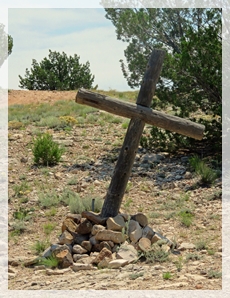 My mother had been very clear—she was to be cremated and her ashes tossed into our rose garden. I was only fifteen when she died and filled with teen-age indignation when my father interred her ashes in a cemetery plot. Angrily I asked how he could go against her wishes. He simply replied, “Following her wishes is far easier said than done.” What had seemed so easy in theory was, in actuality, far too difficult for the grieving man to do. Burdened by my own grief, I didn’t understand; older and wiser, I do now.
I thought of my father’s reply when a friend mentioned the difficulty of planning her husband’s Celebration of Life Service—she wanted to do one thing but family members insisted on another. A few days later, I overheard two other widows discussing their husbands’ cremains—neither woman felt ready to dispose of them and yet they were being pressured to do so by family members. Grief is hard enough by itself; family dissension only makes it worse.
Each of us grieves in our own way and at our own pace. In his grief and loneliness, my father made some rash and foolish personal choices. I dealt with the loss of my mother in acts of teen-age rebellion and reckless stupidity. A friend reluctantly went off to college just a few weeks after her father died and ended up sitting in her dorm room in tears. Grief-stricken and unready to move on with her life, she flunked out of school. Once done mourning, she returned to school and graduated with honors! While none of us handled our grief well, we all needed to pass through that dark valley the best we could, just as my widowed friends will do in time.
Rather than telling our friends and family what they should do and how to behave in their grief, perhaps we could take a lesson from Abe and Sarah, a long-married couple with whom I attend Bible study. Sitting across the table from me, they’d left an empty chair between them. Jokingly, I asked if they were annoyed with one another. No, they were just leaving a spot for the recently widowed Mary. She and her husband used to sit across from them at Bible study. Not wanting Mary to sit by herself, they now save a place for her between them so she won’t feel alone. That, I thought, is what church family does for one another—they walk together in the dark valley of sorrow.
For those who mourn, that dark valley can seem long, gloomy and desolate. A Christian knows he is never alone in his grief—God is always with him. The Bible, however, is abundantly clear—we are to bear one another’s burdens. When someone is walking in the valley of sorrow, as brothers and sisters in Christ, we are to make their journey easier by offering our love, encouragement and support, and possibly even by saving a chair for them.
Do not mourn the dead, but comfort the living. [Jonathan Lockwood Huie]
Rejoice with those who rejoice; mourn with those who mourn. [Romans 12:15 (NIV)]
 I never thought attending a concert by the U.S. Army Field Band and Chorus would make me feel so out of touch with social media, but it did. It began when the audience was asked to choose the evening’s encore by voting on Twitter or Facebook. As the evening progressed, we learned that we could get the latest band news on Google Plus, see a live video stream on Periscope, watch webcasts on the band’s website, sign up for an email newsletter, see band videos on YouTube, tweet about them on Twitter, like and follow them on Facebook, view photos on their Flickr gallery, and purchase their music on Google Play. Since most of us had never even heard of Periscope, we stuck to watching them perform on stage rather than on our phones!

 As I picked up another starfish and tossed it back into the water, I thought of Loren Eiseley’s essay about saving starfish and making a difference in people’s lives, one life at a time. Remembering Eiseley’s essay got me thinking about an announcement made last week at Bible study. While a local family was driving home from church last Easter, a driver sped through a red light, t-boned their car, and changed their lives forever. Their two small children were seriously injured and one, a three-year old girl, was airlifted to another town. On life support for about a month, her injuries left her a quadriplegic. Now four, this sweet little girl has more surgeries and months (if not years), of medical, physical and occupational therapies ahead of her. Meanwhile, her family struggles with mounting medical expenses. Although the family does not attend our church, their need came to the attention of our pastor. Being restricted to a wheelchair has kept this little girl and her family from their favorite Florida activity—going to the beach. Since the wheels of a normal wheelchair would sink in the sand, family beach time has been just a memory until now. Yesterday, along with a sizeable check to help with their expenses, our church presented them with a sturdy all-terrain beach wheelchair. This vehicle enables her not just to go to the beach but also to go into the ocean and play in the water once again.
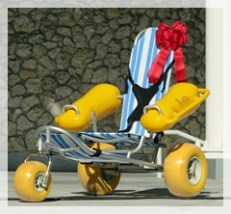 With their huge medical bills and needs, the $2,200 spent on a wheelchair may seem a little frivolous—but not to a four-year-old girl who had given up all hope of ever going to the beach or feeling the waves again! There are some people who will analyze how many mission trips, meals, blankets, immunizations, medicines, bricks, or Bibles could have been purchased with that same amount of money. They may disagree with how the church spent our tithes and offerings. Without a doubt, there is a tremendous need in our world for just the bare necessities of clean water, food, shelter, and health care. Sometimes, however, a need is right in front of us—a need to make life a little easier for a neighbor, a need to bring some joy back to a family or to put a smile back on a child’s face. Sometimes what seems extravagant to someone is a necessity to another—a great wig or a day at the spa for a woman with breast cancer, a davit that allows a paraplegic man to get into his boat again, skiing on a sit-ski for a wounded warrior who’s lost his legs, a week of summer camp for a teen with diabetes, a weekend at Disney for a child with leukemia, a trip to the Super Bowl for a boy with cystic fibrosis, or even a teddy bear for a tot recovering from heart surgery.
 Devotions of the Heart